What did the family pay last year in fees, custody, spreads and financing, across every bank?
Every piece of it is on a statement somewhere. The total is on none of them, and almost nobody adds it up.
We read a year of statements from every bank and manager, and tell you in one week what you paid, what it should cost, and where to act. Afterwards, if it is useful, the same reading continues month by month.
Before any system, any subscription and any change of habit, there is a question worth answering on its own. Across every bank and every manager, what did the family pay last year, and how does that compare with what the market charges?
Never more than €5,000, whatever the structure. Within that, the fee depends on the number of live relationships, the complexity of the perimeter and the state the information arrives in. The exact figure is confirmed in writing once we have seen a sample of the statements, and before any work begins. There is no engagement beyond it.
Most of the time the report finds more than it costs. When it does not, you have the answer anyway, which is worth having on its own.
This is cost work, not investment work. The report says nothing about what the family should own.
Nothing here is exotic, and none of it is hidden. It simply sits in places nobody adds together.
A review answers for one year. Most families want the answer to stay answered, which is what the platform is for. It is offered after the review, to families who want it, and never as a condition of it.
The villa, with its insurance, its maintenance, its staff and its financing, over any period you choose. Not five reports to reconcile by hand.
| Category | Apr | May | Jun | Total |
|---|---|---|---|---|
| Insurance | 3,040 | 3,040 | 3,040 | 9,120 |
| Maintenance | 1,250 | 8,000 | 620 | 9,870 |
| Staff | 6,400 | 6,400 | 6,400 | 19,200 |
| Utilities | 980 | 1,120 | 1,410 | 3,510 |
| Financing | 4,166 | 4,166 | 4,166 | 12,498 |
| All categories | 15,836 | 22,726 | 15,636 | 54,198 |
Every insurance premium paid by every company, property, vessel and person, in one table, with the detail one click below it. This is the answer to the question at the top of this page.
| Element | Type | Budget | Actual | Variance |
|---|---|---|---|---|
| Villa Uno | Asset | 36,480 | 36,480 | 0 |
| M/Y Serena | Asset | 121,000 | 133,400 | +12,400 |
| Alfa Holding | Company | 18,200 | 18,200 | 0 |
| Beta Immobilière | Company | 9,600 | 9,140 | -460 |
| Household | People | 14,300 | 14,300 | 0 |
| All elements | 199,580 | 211,520 | +11,940 |
A recorded walk-through, then the screens themselves. Everything shown comes from a demonstration environment, and every figure in it is fictional.
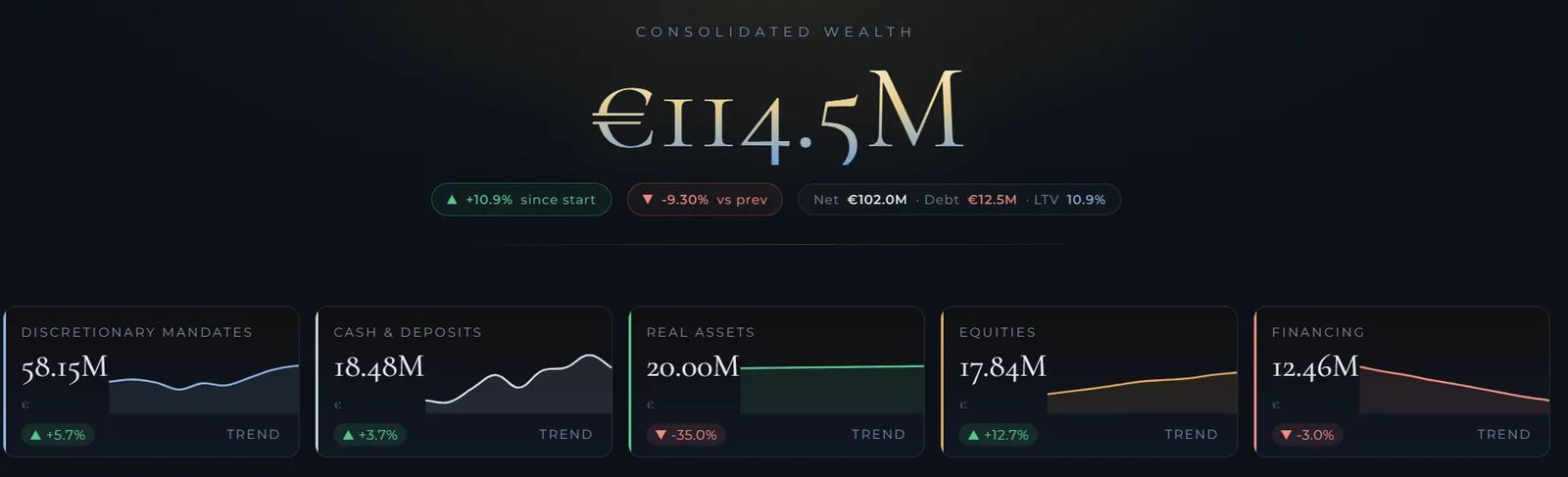
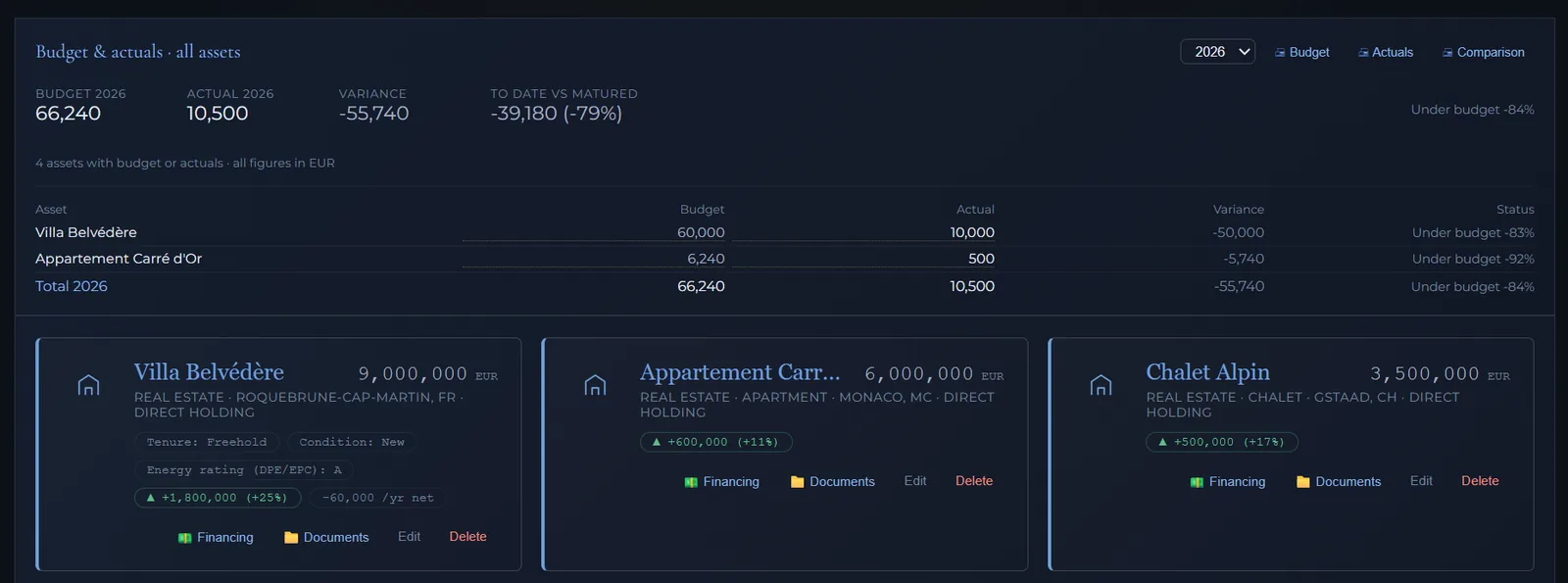
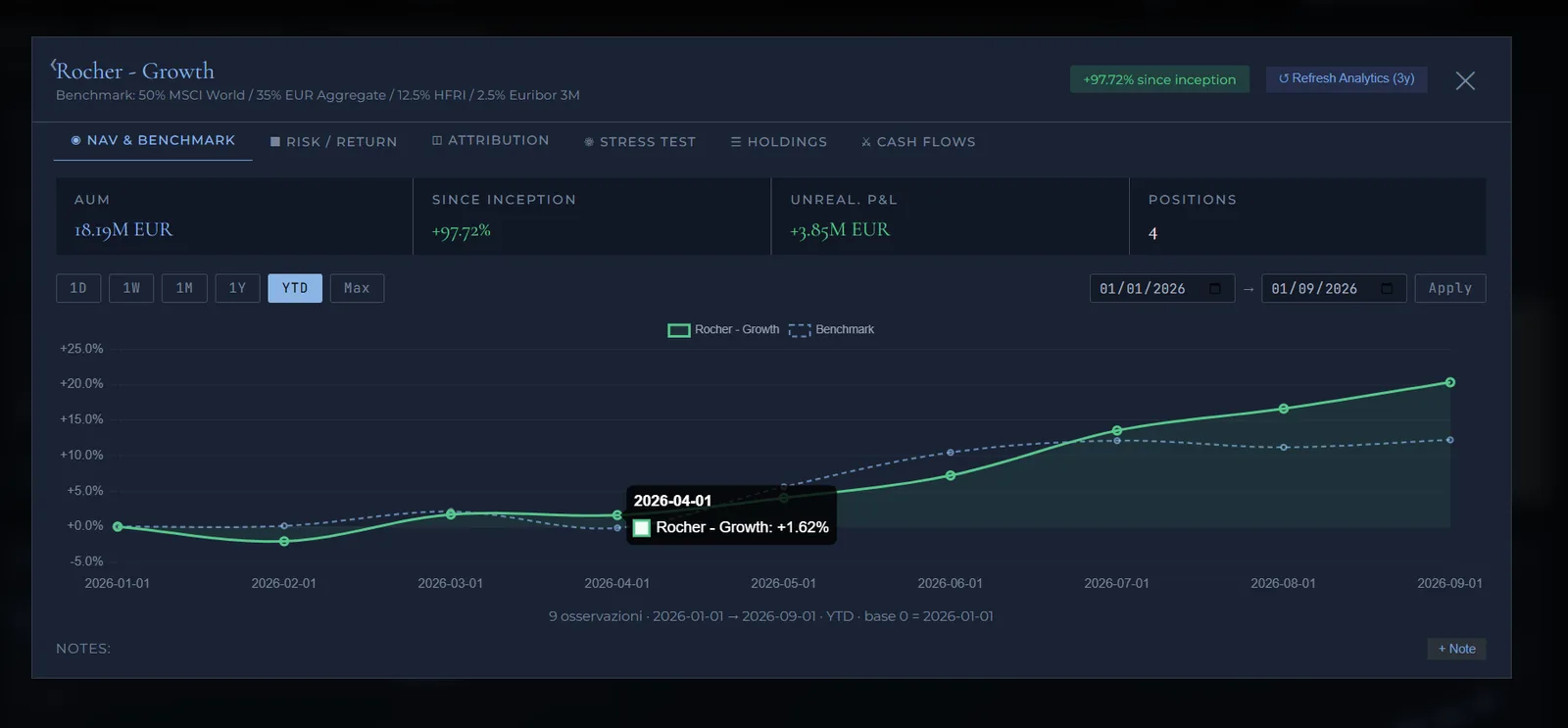
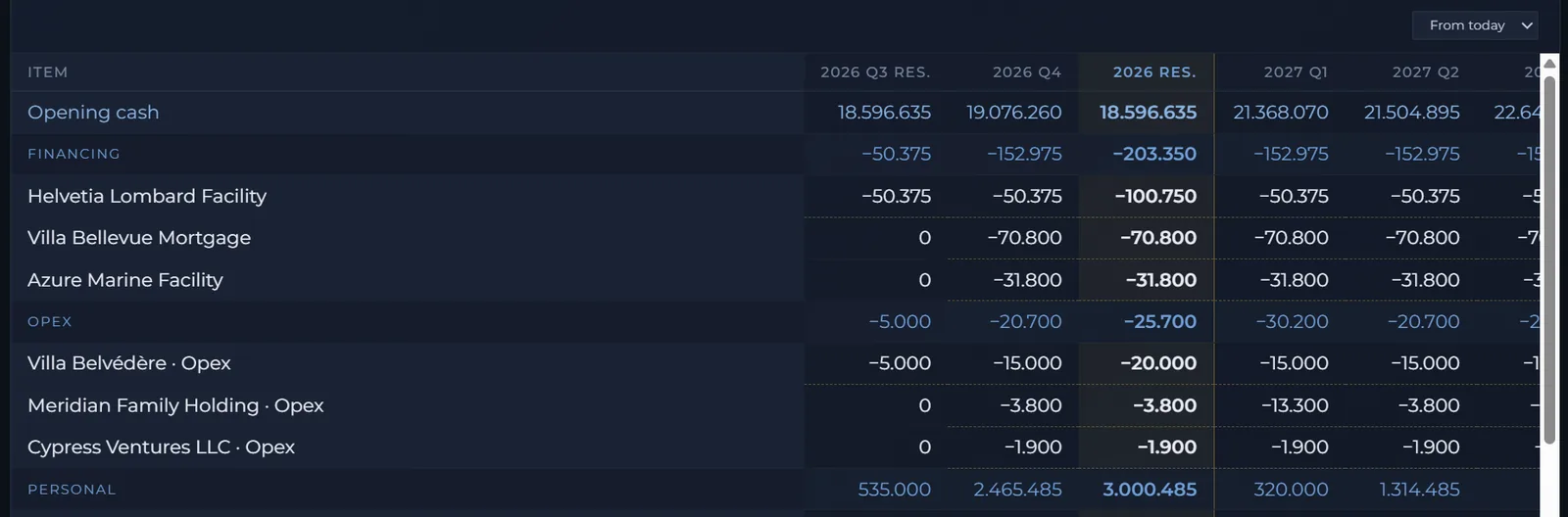
Families are not variations of one another. A structure with four companies and a vessel has little in common with one holding three properties and a private fund, and a platform that treats them the same serves neither well.
The platform is shaped around the family it is built for: its perimeter, its categories, the way it already thinks about its own affairs.
One property and one bank account. What it costs to hold, what was planned for the year and what has been spent, kept straight in one place.
Holding companies across several jurisdictions, a dozen banks and managers, properties, a vessel, private funds, and the people who own them. Consolidated into a single reading, and still readable asset by asset.
The same platform serves both. What changes is how much of it is switched on, not what it is built from.
A new report, a different breakdown, an added category: answered within twenty-four hours, at a modest cost. Not queued for the next release.
There is no automatic link to any bank. The platform adapts to the statements the family already receives, which means no login of yours is shared with anyone.
This matters as much as the rest, and it is short.
The reason a family can accept something built to measure is knowing it can walk away with everything, on any morning it chooses.
One command produces a workbook holding every register: assets, companies, people, budget lines, recorded costs, insurance, financing, accounts. It opens in Excel and it is yours. No request, no notice, no fee.
Termination takes effect the day after you say so. What is owed for the unbilled period is paid, and that is the end of it.
Every figure and every document entered remains the family's property, and is returned in full on departure.
There is no list price, because there is no standard case. A family with one property and one bank is a different undertaking from a group spread across several jurisdictions and a dozen banks. The cost follows the structure, and it is agreed in writing before anything begins.
Built and run by Nicola Barbiero, who has spent years working with financial institutions and family offices in Monaco, and who knows this work from the inside.
That is the reason a change arrives within a day rather than in next quarter's release. There is no product committee between your question and the person who can answer it.
It is also the reason the platform speaks the language of the work: perimeters, entities, budgets against actuals, the cost of holding a thing rather than its headline value. None of that had to be explained to anyone before it could be built.
From Monaco to wherever the family and its assets happen to be. The interface is set up in the languages the family and its office actually work in.
Notes on how capital actually moves, and on what the numbers show once they are put side by side. Written irregularly, and only when there is something to say.
Four answers in full, written the way they would be given in a first conversation.
Describe the structure in a few lines. The reply will tell you honestly whether this is the right tool for it, and comes from the person who built the platform.
Correspondence in English, French or Italian. The platform itself is configured in whichever languages the family and its office work in.
For families who would rather be accompanied through their own figures, and through the conversation with their banks about what is actually being charged, that work is done together.
Writing weekly on how capital moves, at Money Talks, Borders Don’t, and on LinkedIn.