October 27, 2026
Humility is a technique
A few years ago I spent several weeks on an investment.
Due diligence done properly. The numbers rebuilt from source rather than taken from the deck. A model with the assumptions stressed in three directions. Comparable transactions, the structure, the exit routes, the things that could go wrong ranked by how much each would cost. I walked into that meeting as well prepared as I have ever been for anything.
I presented it. The family listened politely, and asked two or three sensible questions. Then one of them mentioned that they had spoken to somebody the previous week, for about a quarter of an hour, and that they were going to do it.
Fifteen minutes, against several weeks.
They were right. Not lucky, right, and the reasons became visible over the following two years, and not one of them was in my model, because not one of them could have been.
I spent a while after that being annoyed, which was the wrong reaction, and then a much longer while understanding it, which was the useful one.
Here is what I had missed. That quarter of an hour was not a shortcut taken instead of analysis. It was an input I did not have. The person they spoke to knew something specific about the people on the other side of the table, the kind of thing that never appears in a data room and never will. My weeks of work had produced an excellent answer to the question I had asked myself. Their fifteen minutes had answered a different question, and that turned out to be the one that decided the outcome.
And it had not once occurred to me to ask them what they knew. Which tells you quite precisely what I thought my job was.
Let me block the obvious misreading
Before going further, because this is where a piece like this usually goes wrong.
This is not an argument that instinct beats analysis, or that a conversation with a friend substitutes for due diligence. I have also sat in rooms where a family did exactly that and lost a great deal of money, and in some of those rooms I was the one saying so and being overruled. One case proves nothing at all. If I had come out of it believing that analysis is overrated, I would have learned the wrong lesson and would be worse at this job, not better.
The claim is narrower and it survives the counterexamples. The model and the conversation were answering different questions. Only one of us knew that there were two.
The family is not playing in your league
The clearest explanation I know of why that happens comes from an economist writing in 1945.
Hayek's essay on the use of knowledge in society makes an argument about central planning that applies, uncomfortably well, to advising. The knowledge that actually determines outcomes, he said, is not scientific knowledge. It is knowledge of the particular circumstances of time and place. It is dispersed among many individuals, it exists nowhere in concentrated form, and crucially it cannot be conveyed to a central authority in statistical terms. The man on the spot knows things the planner cannot be told.
In our world, the adviser is the planner. The family is the man on the spot.
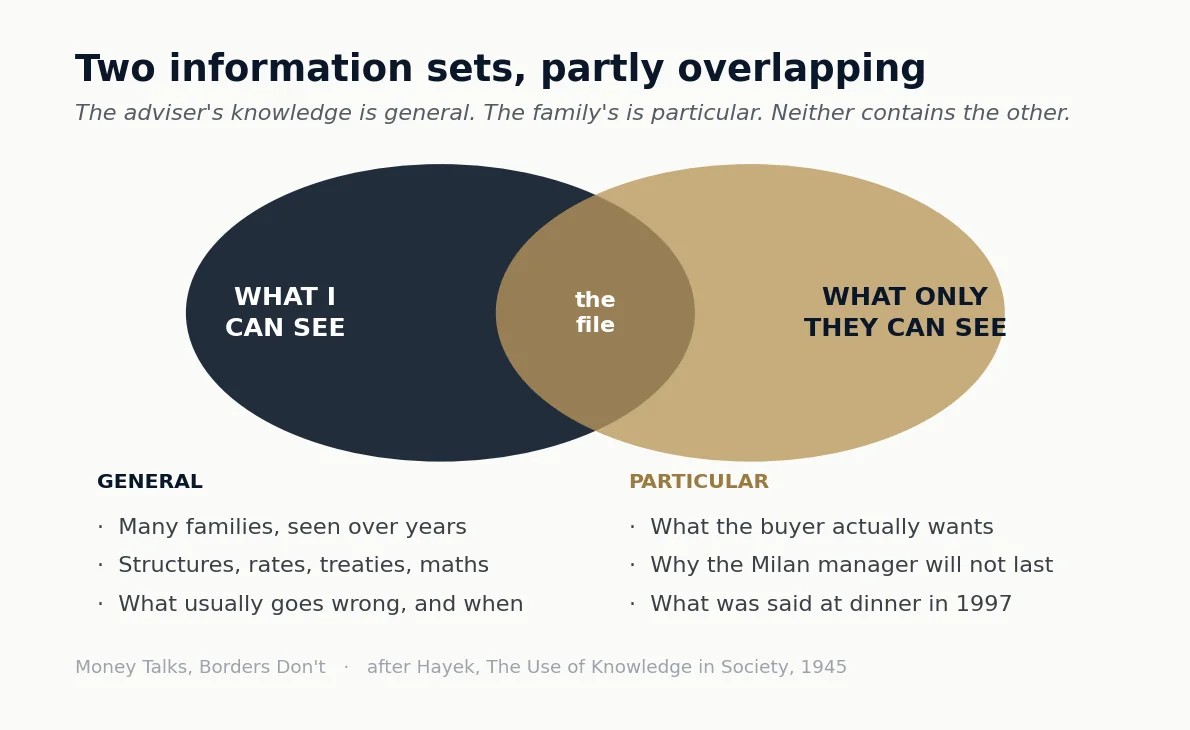
Look at what sits on each side. I bring the general: many families seen over many years, structures, rates, treaties, the arithmetic, and a decent sense of what usually goes wrong and roughly when. That is real, and it is worth paying for.
They bring the particular, and the particular is usually decisive. What the buyer actually wants, as opposed to what the buyer's lawyer wrote. Why the manager in Milan will not last another two years, which they know from a tone of voice in September. What was said at a dinner in 1997 that explains why the two branches of the family cannot sit on the same board. Which politician takes calls. Which competitor is quietly in trouble.
None of that is in the file. Most of it cannot be put in the file, which is Hayek's whole point.
And there is a second asymmetry on top of the informational one. A principal at that level is exposed to flows of information I simply do not have access to. Other families, deals that never reach a market, boards, foundations, a phone that rings with things that will be in the newspapers in six months. They are, in the most literal sense, playing in a different league, with a different ball.
The asymmetry nobody writes down
Then there is the consequence, which settles the question of who decides.
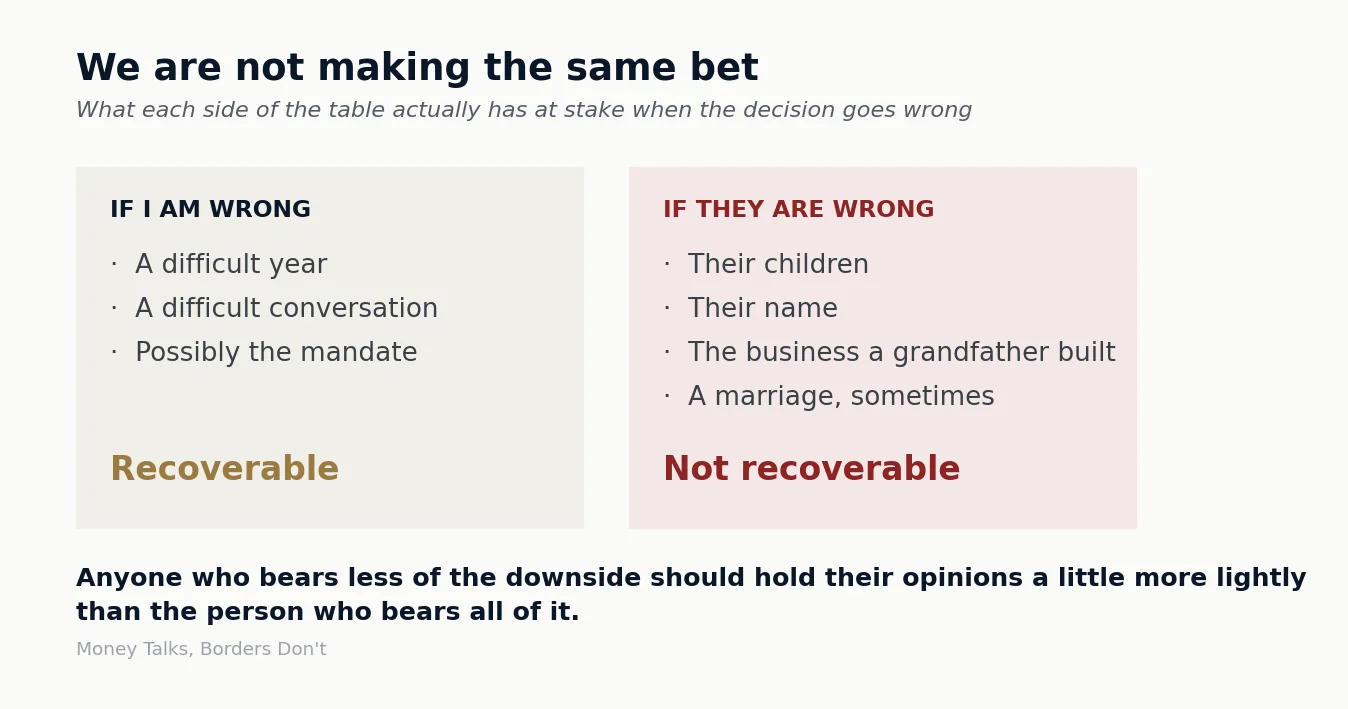
If I get it wrong, I have a difficult year and possibly a difficult conversation about my mandate. If they get it wrong, it lands on their children, their name, their marriage and the business their grandfather built. We are not making the same bet, and anyone who bears less of the downside should hold their opinions a little more lightly than the person who bears all of it.
This is not an argument for passivity. The previous issues argued the opposite, and I stand by every word: say the uncomfortable thing, make dissent structural, choose your moment. But there is a version of professional confidence that quietly becomes arrogance, and it has a tell. It shows up as the belief that the client's hesitation is a failure to understand you, rather than a signal that they know something you don't.
Nine times out of ten, when a principal pushes back on good analysis, they are not confused. They are holding a piece of the picture you cannot see and have not asked for.
So what does humility actually look like
The word has a soft reputation it does not deserve. Treated properly it is not a virtue, it is a technique, and it has steps.
Ask before you advise. The single highest-return question I know, asked at the start rather than the end: what do you know about this that I don't? It is not flattery. It routinely produces the fact that changes the recommendation, and it produces it before I have committed to a position in public. Had I asked it that morning, I would have heard about the fifteen-minute conversation while my model was still open.
Say which part is general and which part is particular. "On the general case, this structure usually fails on substance. On your case, you know the people, so tell me if I'm wrong about the Milan office." That sentence costs nothing and it tells the family exactly where their knowledge is needed, instead of leaving them to guess whether disagreeing is allowed.
Give ranges and odds, not verdicts. "I'd put this at sixty-forty" is more useful and more honest than "you should", and it has the side effect of making you keep score.
Keep a record of what you predicted. In writing, dated, including the ones you got right so it isn't self-flagellation. Nothing calibrates confidence faster than reading your own file from two years ago. The reason nobody does this is obvious and it is the reason to do it.
And ask the question that makes the hierarchy explicit: whose decision is this, actually? Say it out loud. In almost every case the answer is theirs, and naming that fact makes it far easier for them to hear advice they might otherwise have had to defend themselves against.
Where this leaves the trade
Several issues in a row now I have been circling the same conclusion from different angles, so let me put it plainly.
The adviser's edge was never that he knows more than the family. In most of the ways that decide outcomes, he knows considerably less. The edge is narrower and more specific: he has seen many versions of this situation, and they have seen one. He can tell them how it usually goes. He cannot tell them how theirs will go, because theirs contains a thousand particulars that only they have access to.
The job is to combine two partial pictures, and the first step is admitting out loud which half of it you are holding.
It took me fifteen minutes to learn that, and several weeks to understand it.
For analysis, not advice. The account above is described in general terms and identifies nobody. Every situation should be assessed with your own advisors.
---
Sources & notes
The argument on dispersed knowledge is Friedrich Hayek's, in "The Use of Knowledge in Society" (American Economic Review, 1945), which distinguishes scientific knowledge from knowledge of the particular circumstances of time and place, holds that the latter exists only in dispersed form among individuals, and argues that it cannot be conveyed to a central authority in statistical form. The phrase "the man on the spot" is his.
On the asymmetry of consequence, the general point that those exposed to the downside of a decision hold a different standing from those who are not is most associated with Nassim Taleb's work on skin in the game.
The opening account is the author's own, described in general terms, with no counterparty, sector, jurisdiction, amount or date identified.
References: Hayek (1945), Taleb.