October 20, 2026
Two words for time
Last Monday in Stockholm, the Nobel prize in economics went to Robert Hall and Michael Woodford, for work on how governments and central banks can smooth the peaks and troughs of an economy. The academy's phrasing is worth noticing: the measures have to be well timed.
But the sentence that stayed with me came from the press conference afterwards. Woodford said that stabilising an economy is not an exercise conducted by people simply "pulling levers to control the economy", independent of what everyone else understands.
That is the whole job, expressed better than I've managed in fifteen years of trying.
Last week we ended on the last two metres: the distance between a correct analysis and a decision the family actually takes. This is that piece. Because policy and advice have the same problem. The answer is the easy part. Getting it to land is the work, and it depends on two things that no spreadsheet contains, which are what the other person understands and when you choose to say it.
First, the part nobody admits
Before the philosophy, the uncomfortable ground floor.
An employed adviser in a family office is not a consultant. A consultant has twelve clients and can afford to lose one. The employee has one, and that one pays the salary, signs the bonus, knows everyone this person would ever work for next, and often sits two floors above their own family's future.
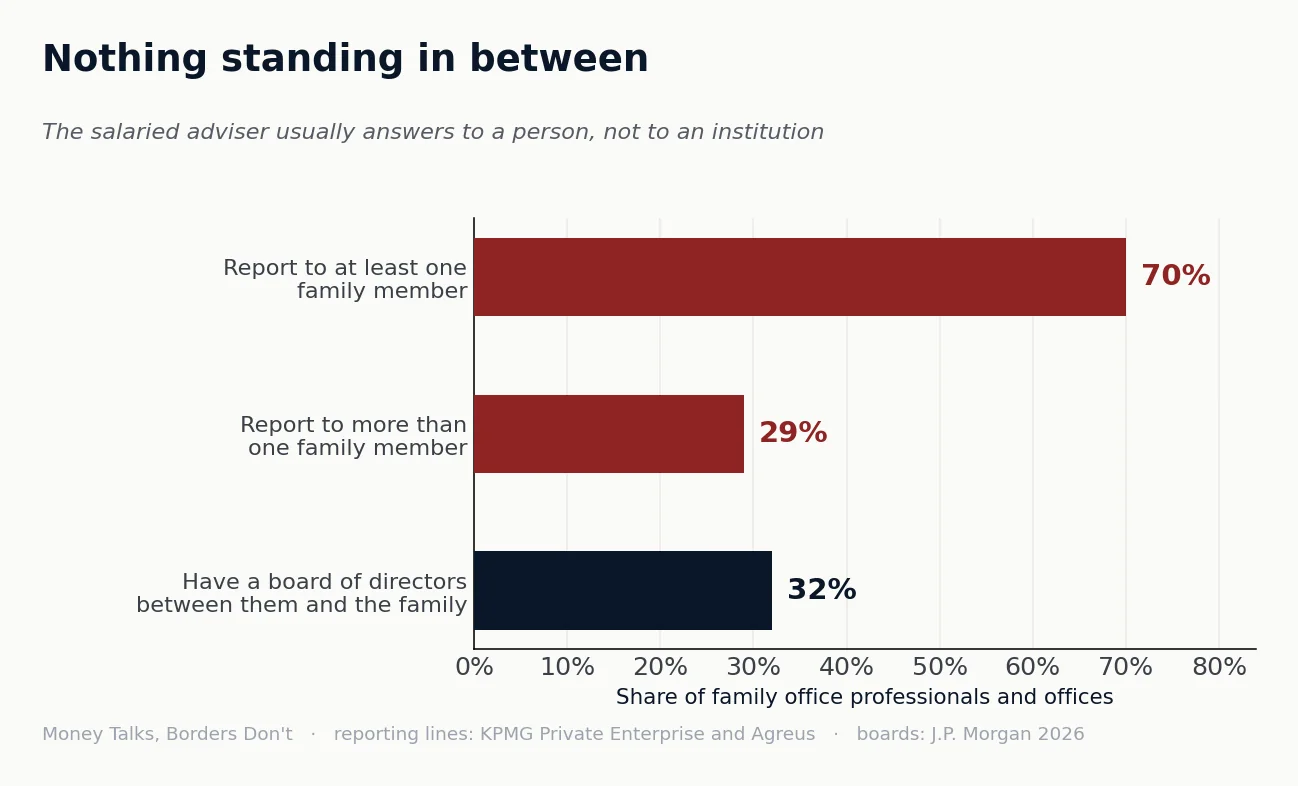
The numbers describe the shape of it. Around 70% of family office professionals report to at least one family member, and 29% report to more than one. Only about a third of offices have a board sitting between the family and the people who work for it. For most, there is no institution in between. There is a person.
And in places like Monaco or Switzerland it goes further, because a salaried adviser's residence permit is usually attached to the job. Disagree badly enough and you aren't changing employers, you're changing countries, and possibly schools for your children.
So when we say someone should "just be honest", we're asking them to accept a personal risk that has nothing to do with professional standards. This isn't an excuse, and last week's piece argued that the fix is structural rather than moral. But any honest discussion of communication inside a family office has to start by admitting what speaking costs the person doing it. The ones who manage it are not braver. They're better at choosing the moment.
Which brings me to the Greeks.
Chronos and kairos
Ancient Greek had two words for time, and the distinction is the most useful thing I know about this job.
Chronos is clock time. Sequence, duration, deadlines, the thing a calendar measures. Kairos is the opportune moment: the right time rather than the amount of time. An archer's word, for the instant when the shot is available.
Our whole industry is trained in chronos. Efficiency means closing the loop, clearing the item, delivering the recommendation the moment the analysis is finished. Modern professional life rewards that relentlessly, and it is exactly the wrong instinct in a family.
Because a recommendation delivered too early is not early. It is wrong. It will be rejected, and a rejected idea is far harder to raise a second time than an idea nobody has heard yet.
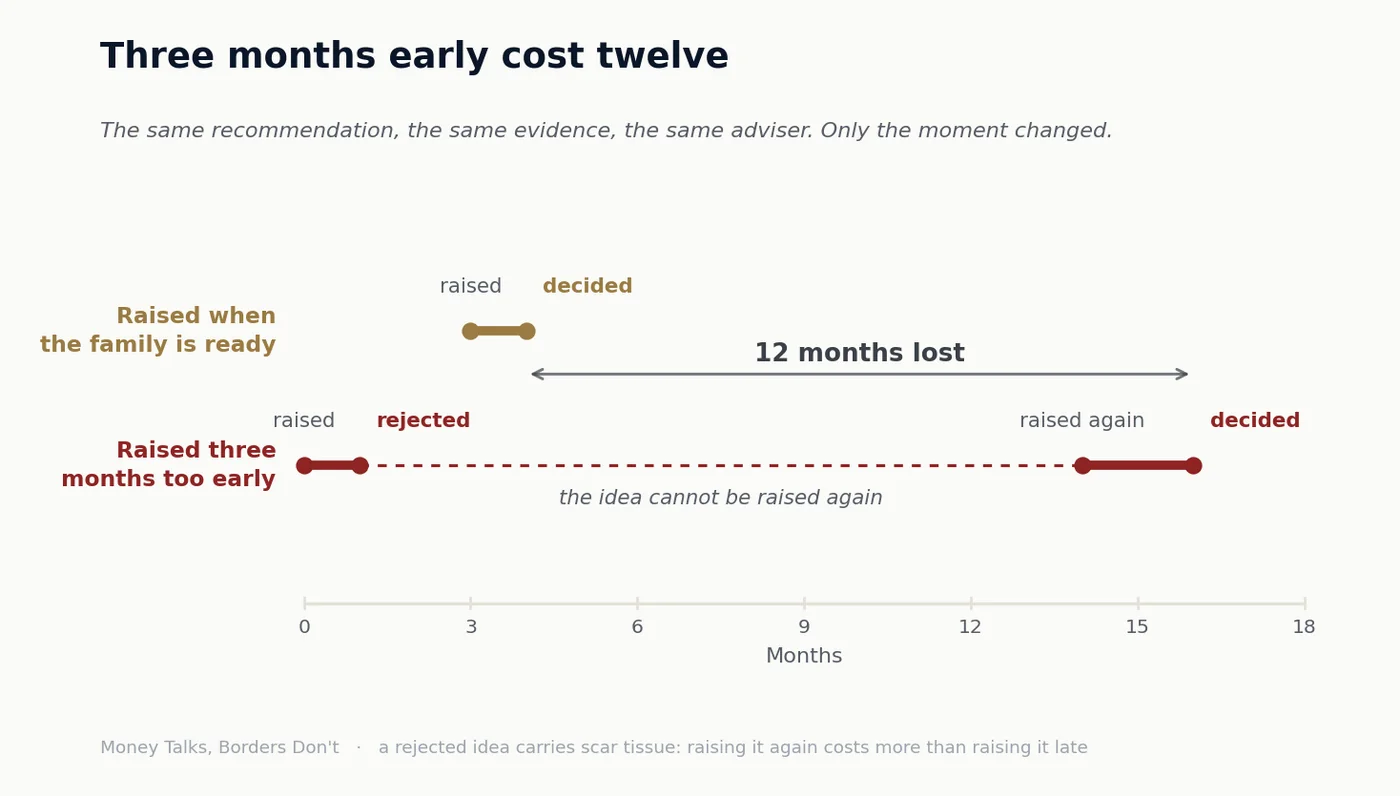
Here's the pattern I've watched more than once. The analysis is finished in January. The adviser, being competent and conscientious, presents it in January. The family isn't ready, for reasons that have nothing to do with the merits: a difficult quarter, a death in the family, an unrelated argument about something else entirely. The idea gets refused.
Now watch the cost. The same idea cannot come back in February, because it was just refused and nobody wants to look as though they're relitigating. It comes back fourteen months later, when enough has changed that raising it is no longer awkward.
Three months early cost twelve months of delay. The adviser did nothing wrong by any professional measure. He was efficient, in chronos, and catastrophic in kairos.
This is the part that feels like heresy to anyone trained in a bank: sitting on a finished recommendation for six weeks, deliberately, can be the highest-value thing you do all quarter. Not because the analysis improves. Because the ground does.
Why the idea has to be theirs
Now the second half, which is psychological rather than temporal.
There's a well-documented reflex called reactance, described by the psychologist Jack Brehm in the sixties: when people sense their freedom to choose is being squeezed, they push back, sometimes against their own interest. The pressure itself generates the resistance, independently of the content.
Family principals have reactance in unusual quantities, and for good reason. Most of them built something precisely by refusing to do what they were told. The quality that created the fortune is the same quality that now makes it hard to hand them a conclusion.
Which is why the oldest technique in Western thought remains the most effective one in this work. Socrates' mother was a midwife, and he described his own method as midwifery: he didn't deliver truths to people, he helped people deliver their own. He asked questions until the other person produced the answer, and because they produced it, they believed it.
In a family office this isn't a rhetorical flourish. It's operational. A decision the family reaches is implemented. A decision imposed on the family is implemented slowly, revisited quietly, and abandoned at the first bad quarter.
In practice it's very simple and quite hard. Instead of saying the building yields two percent and we should sell it, you ask what this building would need to earn before we'd call it a good decision today. They do the arithmetic themselves. The number is now theirs, and so is the conclusion, and you have not spent a single unit of the credibility we talked about last week.
The cost is your ego, which is a cheap currency in this job and should be treated as such. The adviser who needs to be seen to be right is usually the one whose advice gets ignored.
Three conversations, not one
Which brings us to the most practical thing in this piece.
Most difficult recommendations need three separate moments, and the single most common mistake made by intelligent people is compressing them into one meeting.
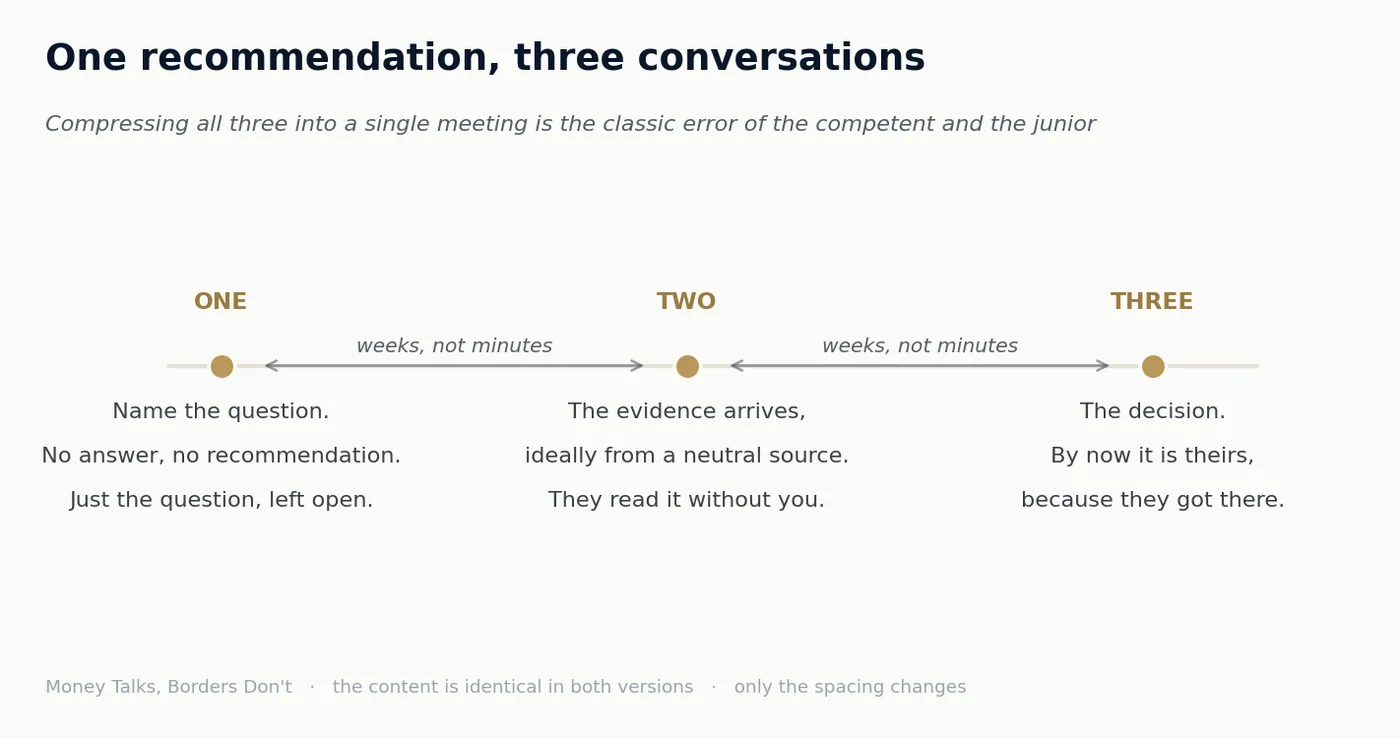
The first conversation names the question and stops. No answer, no recommendation, no deck. Just the question, left open, so that it starts working on its own. "At some point we should probably look at what the Milan building is actually doing for us."
The second conversation brings evidence, ideally from somewhere other than you. An external valuation, a bank's note, a peer's experience. The family reads it without you in the room, which removes the social dimension entirely and leaves only the facts.
The third conversation takes the decision, and by then it isn't your idea. It's a conclusion they arrived at, with help, which is the only kind that survives.
Same content. Same facts. Same adviser. The only variable is the spacing, and the spacing determines whether anything happens.
And the one rule I'd defend to the death: never ask for a decision in the same meeting that delivers a surprise. Surprise and decision are both expensive, and nobody does both well at once.
Four rules I'd actually write down
Deliver bad news early, small, and in writing. Deliver large news slowly, verbally, and alone. The instinct to do the reverse is strong and wrong.
Never surprise a principal in front of other people. Not their spouse, not their children, not the board. Whatever is being discussed, the subject becomes the audience the moment there is one.
Separate the moment of information from the moment of decision, always.
And give the thinking time a name. "I'd like to leave this with you until the end of the month" is a sentence that turns waiting into a plan rather than a delay, which protects you from looking slow while the ground does its work.
The last word to the economists
Woodford's point about the levers deserves the close.
Central banks spent decades believing that policy was a mechanism. Set the rate, the economy responds. What the Nobel work describes, among other things, is that it was never a mechanism, because the economy is made of people forming expectations about what you'll do next. The transmission runs through understanding, and understanding has its own timetable.
Our work is the same, several floors down. We like to believe that a good recommendation is a lever. It isn't. It's a sentence that has to find a person in a particular state of mind on a particular morning, and the quality of the analysis determines almost nothing about whether that happens.
Technical competence is now the entry ticket, and it is getting cheaper by the month as the machines get better at it. Knowing the answer is becoming abundant. Knowing when to say it, and to whom, and in what order, remains stubbornly rare.
The Greeks were right to use two words. Most of our industry only knows one of them.
For analysis, not advice. The examples are illustrative and describe no actual family. Every situation should be assessed with your own advisors.
Sources & notes
The 2026 Sveriges Riksbank Prize in Economic Sciences in Memory of Alfred Nobel was announced on 12 October 2026 and awarded to Robert E. Hall of Stanford University and Michael Woodford of Columbia University, for work on the microeconomic foundations of macroeconomic stabilisation, with the Royal Swedish Academy of Sciences noting that on the basis of these models well-timed fiscal and monetary measures can reduce the economy's peaks and troughs. Woodford's remark at the announcement, that stabilisation should not be viewed as an exercise conducted simply by pulling levers independent of what people in the economy understand, is quoted in part and paraphrased for the rest (Royal Swedish Academy of Sciences; NPR; CNBC; Al Jazeera; CNN, 12 October 2026).
Reporting lines: benchmarking by KPMG Private Enterprise and Agreus found that 70% of family office professionals report to at least one family member and 29% to more than one. Boards of directors are present in 32% of family offices according to the J.P. Morgan Private Bank 2026 Global Family Office Report, which surveyed 333 single family offices across 30 countries.
On residence permits: in several jurisdictions including Monaco and Switzerland, a salaried employee's residence authorisation is linked to their employment. The specific consequences of a change of employer vary by permit type and nationality and should be checked case by case.
Psychological reactance was described by Jack W. Brehm in A Theory of Psychological Reactance (1966), and holds that perceived threats to freedom of choice produce motivational resistance. The maieutic method is attributed to Socrates in Plato's Theaetetus, where he compares his practice to his mother's trade as a midwife, helping others give birth to their own ideas rather than delivering conclusions to them. Chronos and kairos are the two classical Greek terms for quantitative and opportune time respectively.
The three-conversation structure and the four rules are the author's own working practice, offered as experience rather than research.
References: Royal Swedish Academy of Sciences (12 October 2026), NPR, CNBC, CNN, Al Jazeera, J.P. Morgan Private Bank 2026 Global Family Office Report, KPMG Private Enterprise and Agreus, Brehm (1966), Plato, Theaetetus.