November 3, 2026
The letter you'll get in January
Ten weeks from now, on 11 January 2027, a piece of European banking law that almost nobody outside compliance departments has read starts to apply, and a fair number of cross-border families are going to receive a letter about it.
The letter will look administrative. It will mention a directive, use the word "restructuring" somewhere in the second paragraph, and ask for a signature. It will contain a decision that was made about you, in a meeting you were not in, some months ago.
So this week, something harder-edged than the last few issues, and more immediately useful.
What changes
Article 21c of the directive known as CRD VI does something the European Union had left undone for decades. It closes the route by which a bank outside the Union could serve clients inside it without being supervised there.
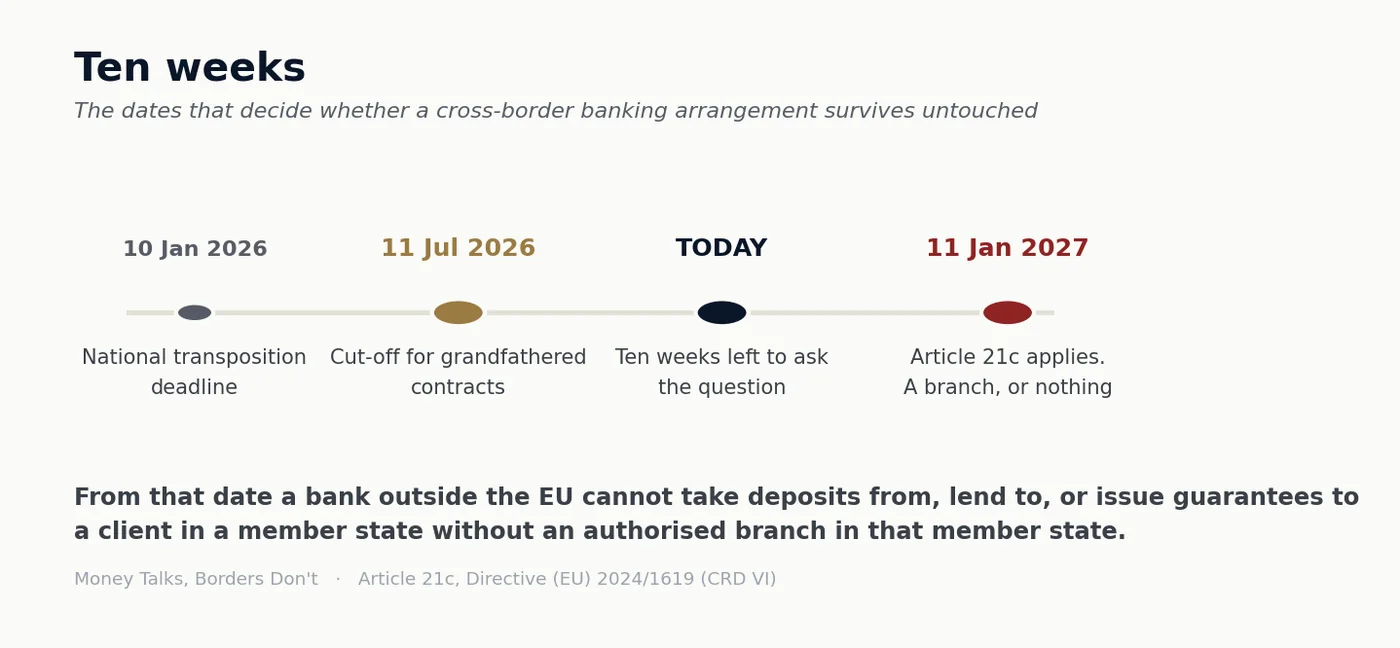
From 11 January 2027, a bank established outside the EU cannot take deposits from, lend to, or issue guarantees to a client in a member state without an authorised branch in that member state. Not in the Union generally. In that member state, one by one, because the authorisation is territorial and there is no passport attached to it. A branch authorised in France does not let you serve a client in Italy.
Two earlier dates matter. Member states had to put the rules into national law by 10 January 2026, and several have gone further than the minimum, which they are permitted to do. And contracts entered into before 11 July 2026 carry transitional protection, which is the single most important date on the page for anyone with an existing facility.
Now the part that decides whether this is your problem.
It catches the loan, not the portfolio
The directive names three activities, and the naming is narrower than the panic around it suggests.
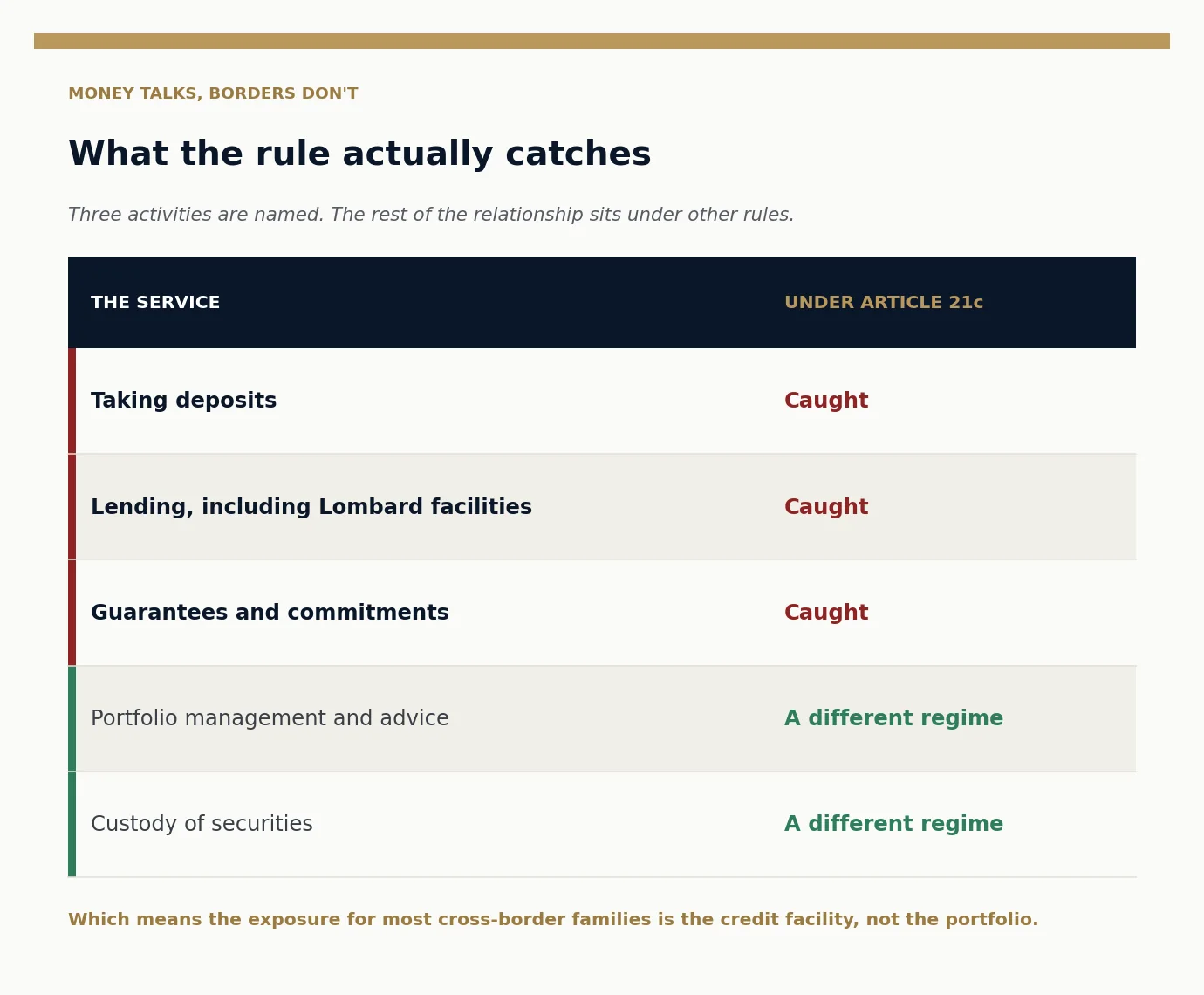
Deposits, lending, guarantees. That is the list. Portfolio management, investment advice and custody of securities are regulated elsewhere, under a different regime, and are not what Article 21c is about.
Read that list against how a cross-border family is actually arranged and the exposure jumps out. The typical structure in my part of the world is a portfolio held with a bank outside the Union, a Lombard facility secured against it, and a borrower resident in Italy or France. The portfolio is not the issue. The credit line is, because lending is on the list.
Which produces a slightly absurd result worth stating plainly: the part of the relationship most families think of as an administrative convenience, the overdraft against the securities, is the part that now carries the regulatory question, while the part they think of as the relationship, the managed money, sits outside it.
A note on Monaco, since a good share of this readership banks there. The position of Monegasque institutions is genuinely not a one-line answer. It depends on each bank's legal form, its ownership and its supervisory status under the arrangements between France and the Principality, and I am not going to flatten that into a tidy sentence to make the article neater. If your facility sits with a bank here and your residence is in the Union, the correct move is to ask the bank directly, in writing, and to get the answer from their legal department rather than from your relationship manager over lunch.
The one door left open, and why it isn't a plan
There is an exemption, and you will hear a great deal about it over the next few months, most of it too optimistic.
Reverse solicitation survives. If an EU client approaches a non-EU bank at their own exclusive initiative, the branch requirement does not apply, and the exemption covers opening the relationship, continuing it, and closely related follow-on services.
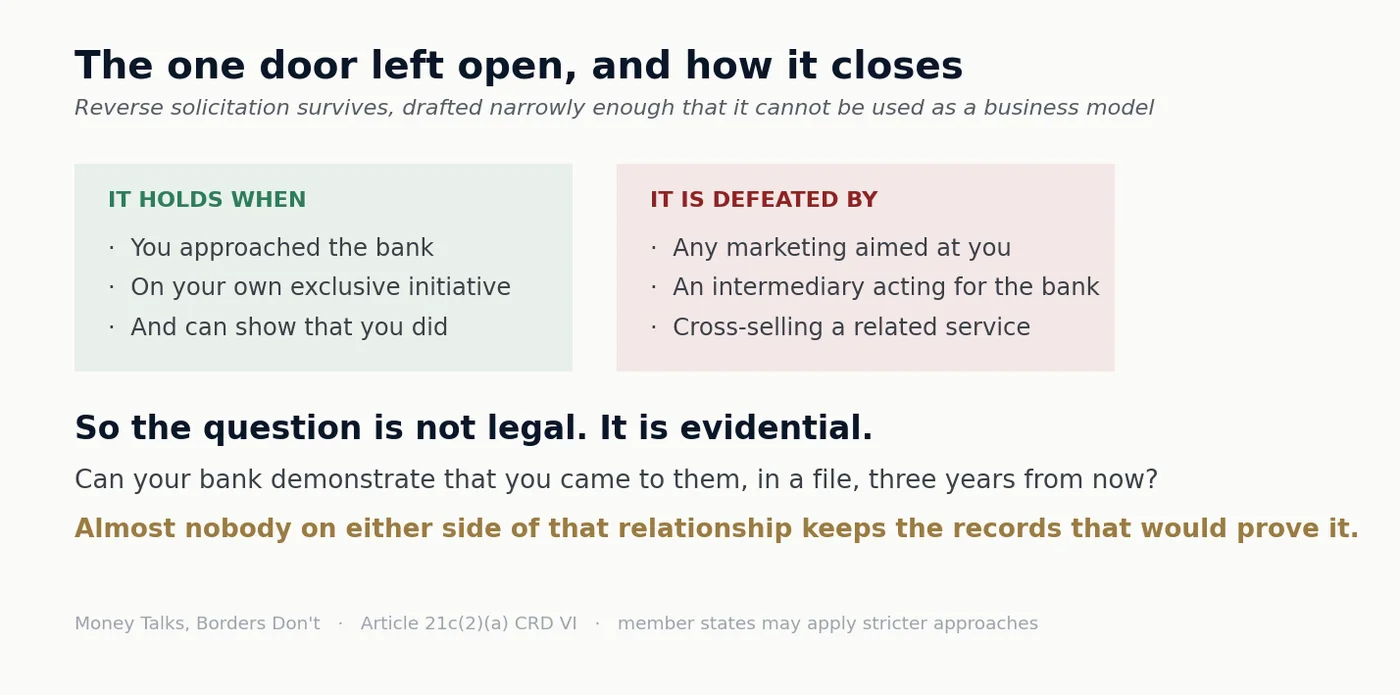
But look at how it is drafted. The exemption falls away if the bank solicited the client, directly or through anyone acting for it or linked to it. Any marketing aimed at you. Any intermediary who introduced you. Cross-selling a related product. Commentators have been blunt about the consequence: it is written so that no institution can build a business on it.
And here is the shift that matters, which is not legal at all. The question stops being what the rule says and becomes what you can show. Can your bank demonstrate, in a file, three years from now, that you came to them rather than the other way round? Can they demonstrate it for a relationship that began over dinner in 2014 through a mutual friend who happened to be a client?
Almost nobody on either side of that relationship keeps records at that standard. Reverse solicitation is an exemption, not a strategy, and treating it as a plan is how families end up discovering in March that the facility they were counting on in February has been withdrawn.
What to do in the next ten weeks
Five things, none of which require a lawyer to begin.
Draw up the actual map. Every banking relationship, where the institution is established, where each borrower is resident, and which of the three named activities is present in each. Most families have never written this down in one place, and the exercise alone surfaces two or three things nobody had thought about.
Find the dates on your facility agreements. Before or after 11 July 2026. That single fact determines whether you are inside the transitional protection or outside it, and it is printed on a document you already have.
Ask what happens at renewal, in writing. This is the question I would put first, because a facility is rarely a static thing: it rolls, it gets amended, limits move. Whether a rollover after the date counts as continuing an old contract or entering a new one is precisely the kind of question where you want your bank's written position on file rather than a reassuring phone call.
Ask the bank what it intends to do, and read the answer for what it reveals. They have three options: open a branch in your country, move you to a group entity inside the Union, or let the relationship go. The speed and specificity of the reply will tell you which category you are in, and that is worth knowing independently of the legal question.
And do it now rather than in January. Everything here is competing for the same small number of people in each bank's legal and structuring teams, and they are going to be busy in exactly the period when everyone else wakes up.
The wider point
We have spent several issues on judgement, timing and humility, so let me close on something more concrete.
Cross-border arrangements are not permanent. They sit on a set of rules that were written by people with their own concerns, and those rules get rewritten without anyone asking whether the arrangement was convenient for you. The families who handle these moments well are not the ones with better lawyers. They are the ones who know what they actually have, in one document, and can therefore answer a question in a week rather than a quarter.
The letter is coming. The only real variable is whether it finds you knowing what you hold.
For analysis, not advice, and this issue touches live regulation. Implementation differs between member states, several have gone beyond the minimum, and the position of any particular institution and facility turns on its own facts. Take advice on your own arrangements.
---
Sources & notes
Article 21c of Directive (EU) 2024/1619 (CRD VI) requires third-country undertakings to establish an authorised branch in a member state before providing "core banking services" to clients in that member state, those services being the taking of deposits and other repayable funds, lending, and the issuing of guarantees and commitments. Member states were required to transpose by 10 January 2026, with the licensed-branch requirement applying from 11 January 2027. Contracts entered into before 11 July 2026 benefit from transitional provisions under Article 21c(5). Authorisation is territorial: a branch may provide core banking services only in the member state that authorised it, and there is no EU passport for third-country branches. Branches are classified into two categories, with Class 1 subject to more stringent capital, liquidity, governance and reporting requirements. Member states may adopt stricter approaches, including on territorial scope, reverse solicitation and legacy business (Farrer & Co; KPMG Law; Skadden; Global Financial Regulation Blog; EBA).
The reverse solicitation exemption is preserved by Article 21c(2)(a), applying where an EU client or counterparty approaches the third-country undertaking at its own exclusive initiative, including for the continuation of services and for closely related follow-on services. It does not apply where the third-country bank has solicited clients in the Union, whether directly or through an entity acting on its behalf, an entity with close links to it, or any other person acting for it. Commentary has noted that it is drafted narrowly enough that it cannot support a scalable business model (The Industry Spread; HLC on Italian transposition; KPMG Law).
Investment services such as portfolio management, investment advice and custody are regulated under separate EU rules and are not the subject of Article 21c.
On Monaco: the treatment of Monegasque institutions under this regime depends on each bank's legal form, ownership and supervisory status, including under the arrangements between France and the Principality. No general conclusion is offered here, deliberately.
References: Directive (EU) 2024/1619; Farrer & Co; KPMG Law Germany; Skadden; Global Financial Regulation Blog; HLC; The Industry Spread; European Banking Authority.