September 22, 2026
Your bank's favourite client
Two central banks moved in the space of six days.
On 10 September Frankfurt raised its deposit rate to 2.50%, the second hike of the year. On the 16th Washington did something it hadn't done since 2023: it raised rates, unanimously, to a range of 3.75% to 4%, and most of the committee expects to do it again before Christmas.
The coverage went where it always goes. Mortgages, the dollar, the stock market. Almost nobody looked at the account most of us check every single day, the one on the banking app. So let's look at it.
The most boring trade in finance
Here's the mechanism, stripped down. When a bank ends the day with spare cash, it can leave it at the central bank overnight. Since 16 September the ECB pays 2.50% for the privilege. No credit risk, no effort, nobody to call. It is the dullest trade in finance and, right now, one of the most reliable.
Now open the ECB's own statistics and find a line most people never read: the average rate euro area banks pay households on overnight deposits. In July it was 0.28%.
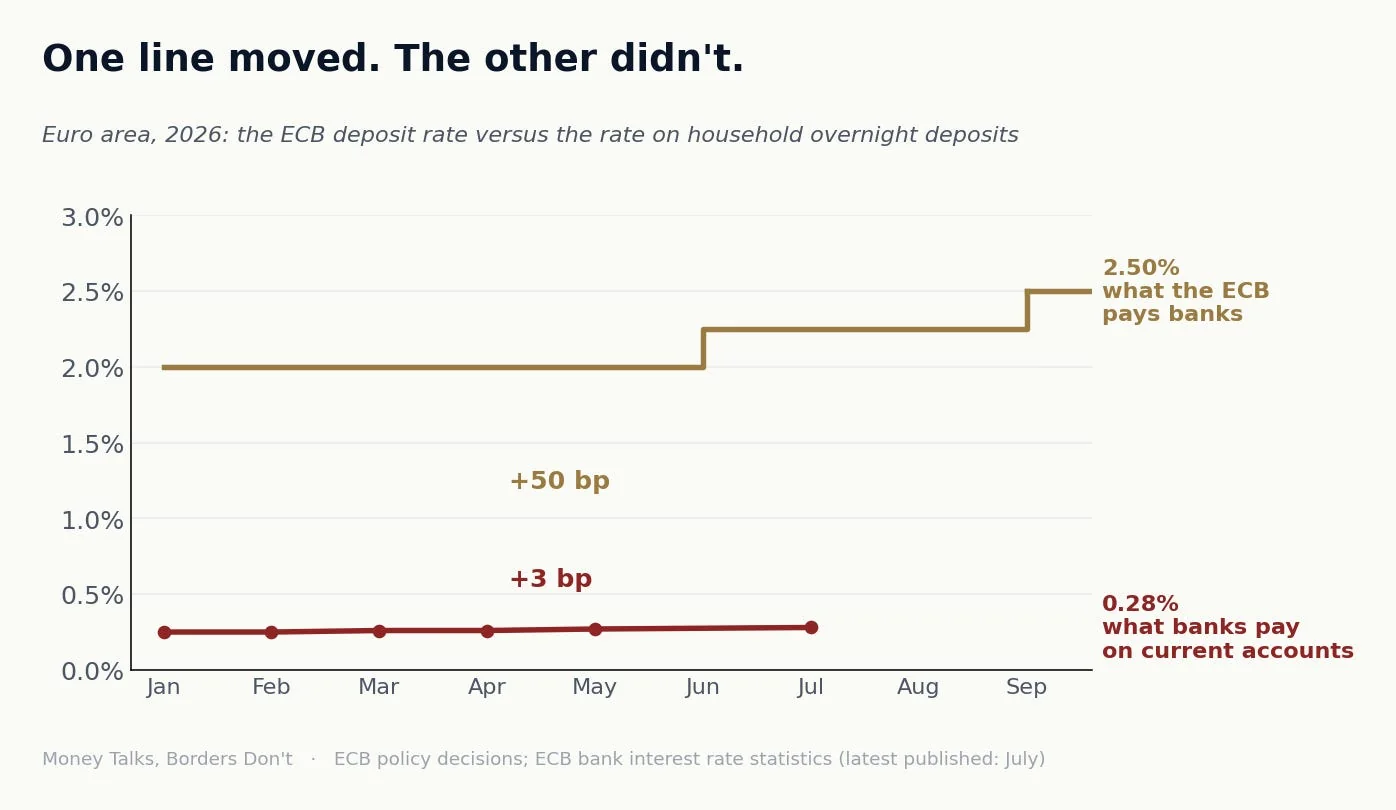
Since January the ECB has raised its deposit rate by half a point. The rate paid on current accounts has moved by three hundredths of one.
Economists have a lovely phrase for prices that shoot up and drift down: rockets and feathers. This year we have both at once, pointed in different directions. If you have a Lombard facility priced off Euribor, your cost went up like a rocket, within weeks. The rate on your current account is going up like a feather, which is to say, when it feels like it.
To be fair to the banks, none of this is a scandal. The spread pays for the payments network, the app, the compliance teams, the contributions to the deposit guarantee scheme, and every "free" service we all take for granted. For an ordinary household holding a few thousand euros, it's a perfectly reasonable arrangement.
The trouble is that the arrangement doesn't scale. Running your account costs the bank roughly the same whether it holds five thousand euros or five million. The spread it earns on that balance does not.
Three prices for one euro
Put this week's numbers side by side.
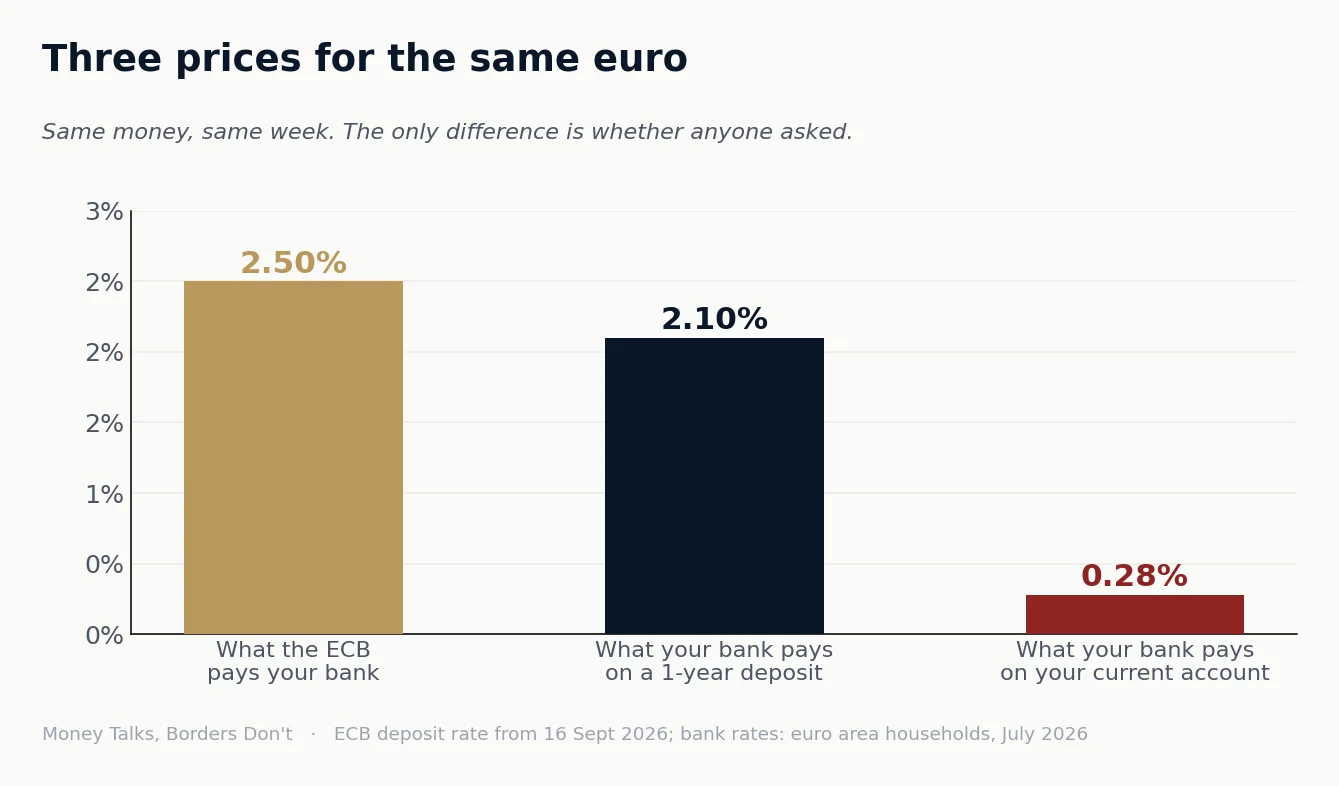
The ECB pays your bank 2.50%. Your bank, on average, pays 2.10% on a one-year term deposit. And it pays 0.28% on the money sitting in your current account.
Between the first two numbers there's a genuine difference: a term deposit ties the money up, and banks need a margin to live. Between the second and the third there's almost no difference in risk at all. It's the same bank, the same guarantee, the same euro. What separates 2.10% from 0.28% is, in most cases, a single conversation that nobody had.
Put a number on it
Picture a family we've all met in some version. Three million euros sitting idle across four banks. Nobody actually decided to leave it there. Part is the proceeds of a property sale, part a dividend from the holding, part the "we'll deploy it after the summer" pile that is now two summers old.
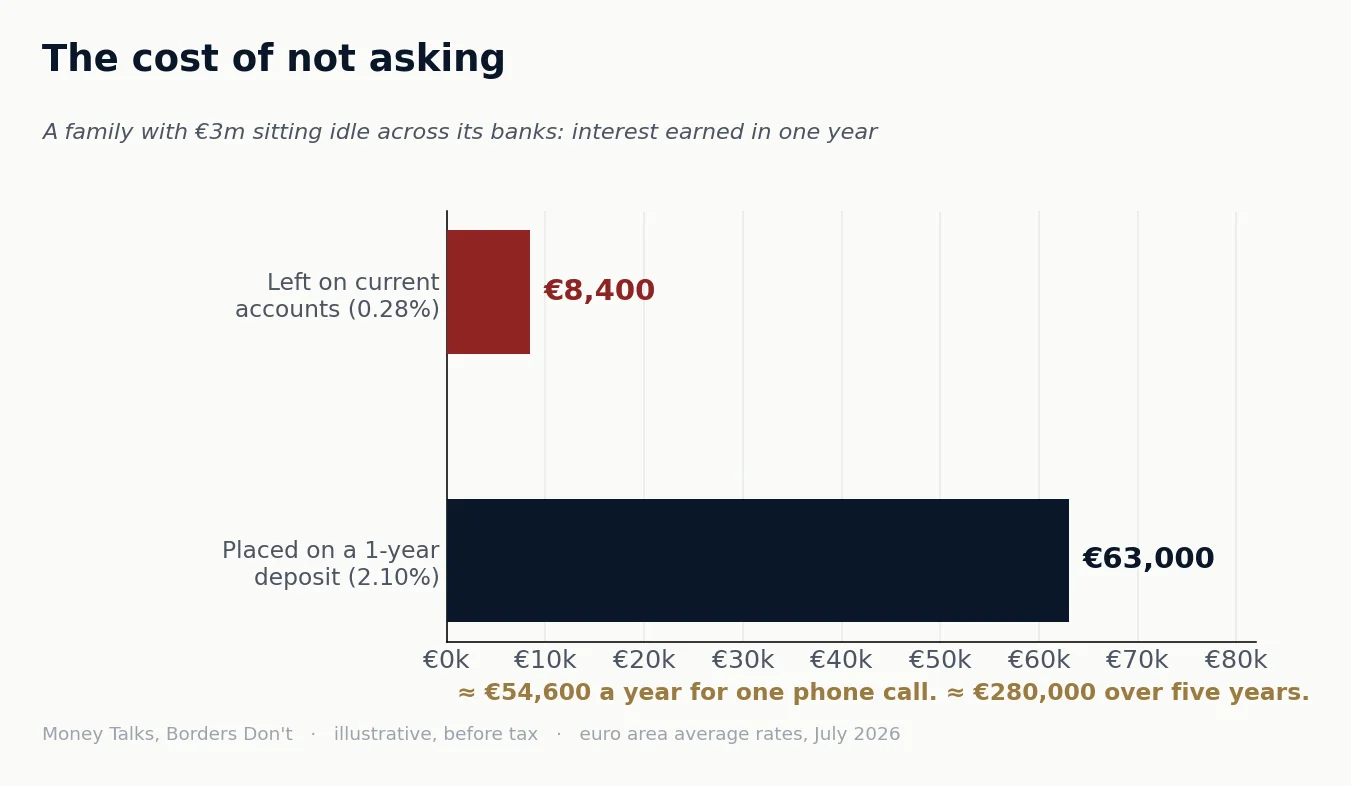
Left on current accounts at the average rate, that's about €8,400 of interest in a year. Placed on a simple one-year deposit, around €63,000. The gap is roughly €54,600 a year, or something like €280,000 over five years, for the price of a phone call and a signature.
And there's a second layer, if you read the piece a couple of weeks ago on inflation. With euro area prices rising 3.3%, a current account paying 0.28% is losing about 3% of its purchasing power every year. On three million, that's close to €90,000 of spending power evaporating annually, quietly, in the safest-looking line of the statement.
Here's what I find genuinely curious, after many years of looking at family balance sheets. The wealthier and more complicated the family, the more likely this pile is to exist. More banks, more entities, more relationship managers, and each of them sees only a slice. The holding company has its account, the SCI has its account, the boat company has its account, the parents have theirs. Every slice looks modest. Nobody's job is to see the total.
The bank, of course, sees its slice perfectly.
Three things for this week
Add it up. Every account, every bank, every entity, including the dull ones. Most families are surprised by the total, and the surprise is usually upward.
Decide what you actually need liquid. Six months of real outgoings plus any known commitments is a sensible starting point. That's the operating buffer, and it belongs on current account. Everything above it is capital, and capital should be doing a job.
Then ask, and choose knowingly. Large balances are negotiable, and there's a whole menu between "current account" and "invested": call deposits, term deposits, fiduciary placements, money market funds, short-dated government paper. Each comes with a trade-off worth understanding before you sign. Deposit guarantees in Europe stop at €100,000 per depositor per bank. A money market fund is an investment, not a deposit. A fiduciary deposit carries the risk of whichever bank ultimately holds the money. None of these is a reason to do nothing. They're reasons to decide rather than drift.
Two central banks raised rates this month to make money more expensive. For your bank, it worked immediately. The only open question is whether it worked for you.
Your bank's favourite client isn't you. It's your balance, and especially the part you forgot about.
For analysis, not advice. Rates shown are euro area averages; the rates on offer to any individual family depend on the bank, the amount and the relationship. Every situation should be assessed with your own advisors.
Sources & notes
Central banks: the ECB raised its three key rates by 25 basis points on 10 September 2026, taking the deposit facility rate from 2.25% to 2.50% with effect from 16 September, its second increase of 2026 after a hike to 2.25% effective 17 June; the deposit rate had stood at 2.00% through the spring. Markets price roughly a two-in-three chance of a further move to 2.75% at the 29 October meeting (ECB; Trading Economics; EBC Financial Group; ECB Watch). The Federal Reserve raised the federal funds target range by 25 basis points to 3.75% to 4.00% on 16 September 2026 by a 12 to 0 vote, its first increase since July 2023; 16 of 18 participants in the dot plot expect a further increase this year (Federal Reserve; CNBC; Advisor Perspectives).
Deposit rates: ECB bank interest rate statistics give the rate on overnight deposits from euro area households as 0.25% in January and February 2026, 0.26% in March and April, 0.27% in May and 0.28% in July; overnight deposits from corporations 0.60% in July; new household deposits with an agreed maturity of up to one year 2.10% in July. The June figure is omitted from the chart for lack of a verified value. In the United States, the national average savings rate was 0.38% as of August 2026 (Raisin).
Worked example: €3 million, simple interest at the July averages, before tax; five-year figure ignores compounding and future rate changes and is rounded. The purchasing-power estimate applies the August euro area headline inflation of 3.3% (Eurostat flash). Deposit guarantee: EU deposit guarantee schemes cover €100,000 per depositor per bank.
References: European Central Bank (monetary policy decisions; bank interest rate statistics, January to July 2026), Federal Reserve Board, CNBC, Advisor Perspectives, Trading Economics, Eurostat, Raisin.