October 13, 2026
Who says no?
Saturday night in Clarksville, Tennessee. A president, on stage, pauses to admire the loyalty of the room and tells it plainly: I could say the stupidest things and you'd clap.
The room clapped.
This newsletter doesn't do American politics and isn't about to start. What interests me is the sentence itself, because it describes a structure rather than a man, and that structure shows up in a great many rooms where nobody votes for anything. Boardrooms. Investment committees. And, more often than our industry likes to admit, family offices.
So here's the question I'd put to anyone who runs money for a family, or whose money is run by somebody else.
When was the last time your adviser told you no?
Applause you can predict is not feedback
Start with the mechanics, because they're cleaner than the morality.
The value of a yes depends entirely on whether no was available. If the answer was never going to be no, then the yes carries no information at all. It isn't agreement. It's acoustics.
A principal surrounded by people who cannot afford to disagree is, in a precise and literal sense, flying without instruments. The dials all read fine because the dials are wired to read fine. This is not a failure of intelligence. Some of the sharpest people I've met in this industry sit in exactly that cockpit, and the reason they don't notice is that everything they hear confirms that they shouldn't worry.
And the room knows. That's the part that makes the Tennessee line so useful: he said it out loud, and they clapped anyway, which is the proof. Everyone in that building understood the arrangement. Nobody experienced it as a problem.
Why agreement is the rational strategy
Now the part that matters, and the reason moralising about yes men misses the point entirely.
The adviser who agrees isn't weak. The adviser who agrees is reading the payoff correctly.
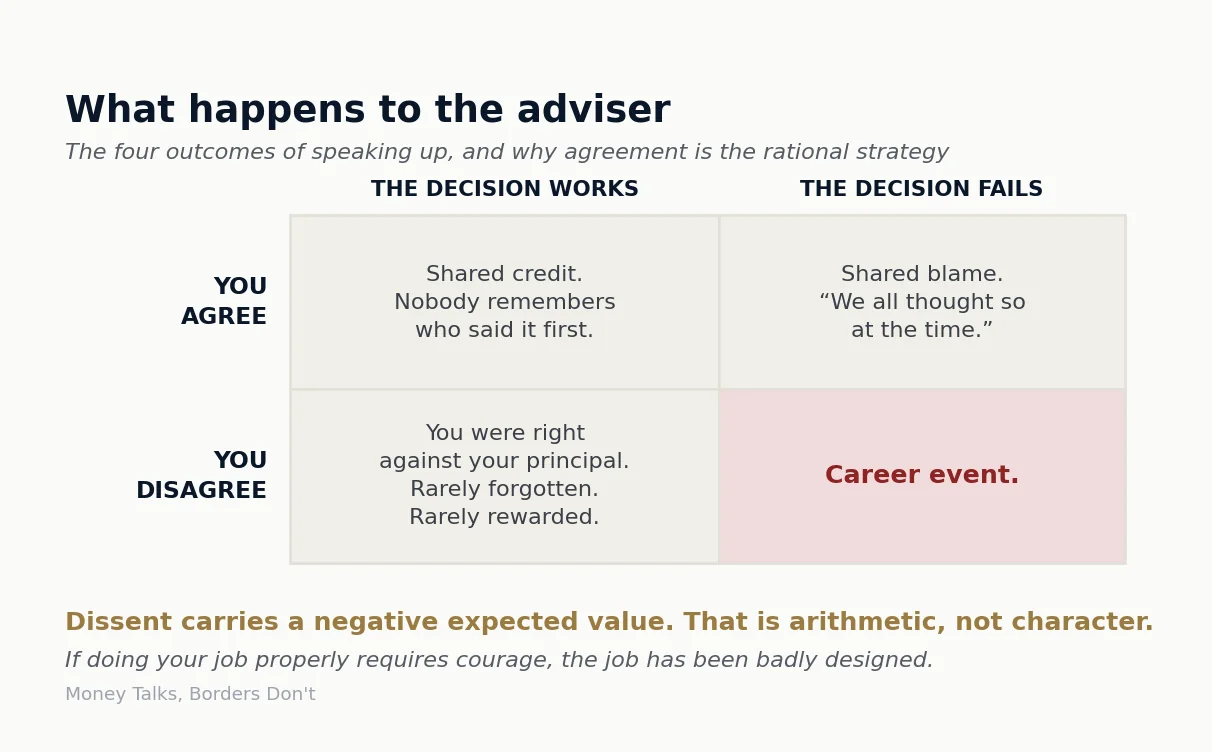
Look at the four outcomes. You agree and the decision works: shared credit, and nobody remembers who said it first. You agree and it fails: shared blame, we all thought so at the time, and the relationship survives. You disagree and you turn out to be right: you were right against your principal, which is remembered differently from being right with him. You disagree and you turn out to be wrong: that one can end a career.
Three of those four outcomes are survivable. The dangerous one sits only on the dissent row.
Which means that for an individual adviser, telling the truth has a negative expected value. That is arithmetic, not character, and it's why hiring "people with integrity" is such a weak control. Integrity is being asked to do a job that the incentive structure is actively punishing.
Here's the line I'd put on a wall: if doing your job properly requires courage, the job has been designed badly.
The missing machinery
And it mostly has been designed badly, which the data shows clearly enough.
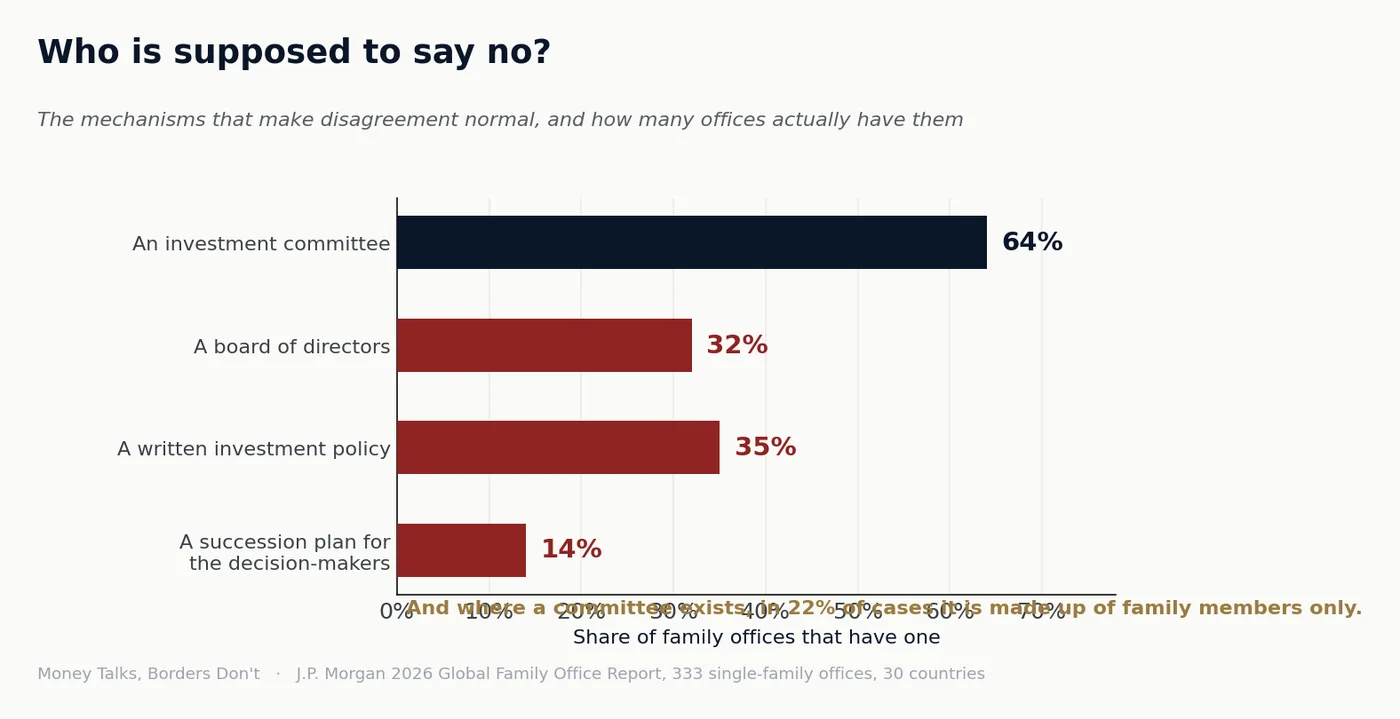
In J.P. Morgan's 2026 survey of 333 single family offices across 30 countries, 64% have an investment committee. Only 35% have a written investment policy. Only 32% have a board. And 86% have no clear succession plan for their decision-makers, which is to say that in most offices the identity of the person who decides is itself undocumented.
One more figure worth sitting with: where an investment committee does exist, in 22% of cases it is composed only of family members. A committee made entirely of the family is not a check on the family. It's applause with minutes.
Put the picture together and most family offices have no mechanism whose explicit job is to make disagreement normal. What they have instead is a hope that the individuals involved will be brave. We've just seen what that hope is worth on the payoff matrix.
What it costs
The cost doesn't arrive as a disaster. It arrives as a pattern.
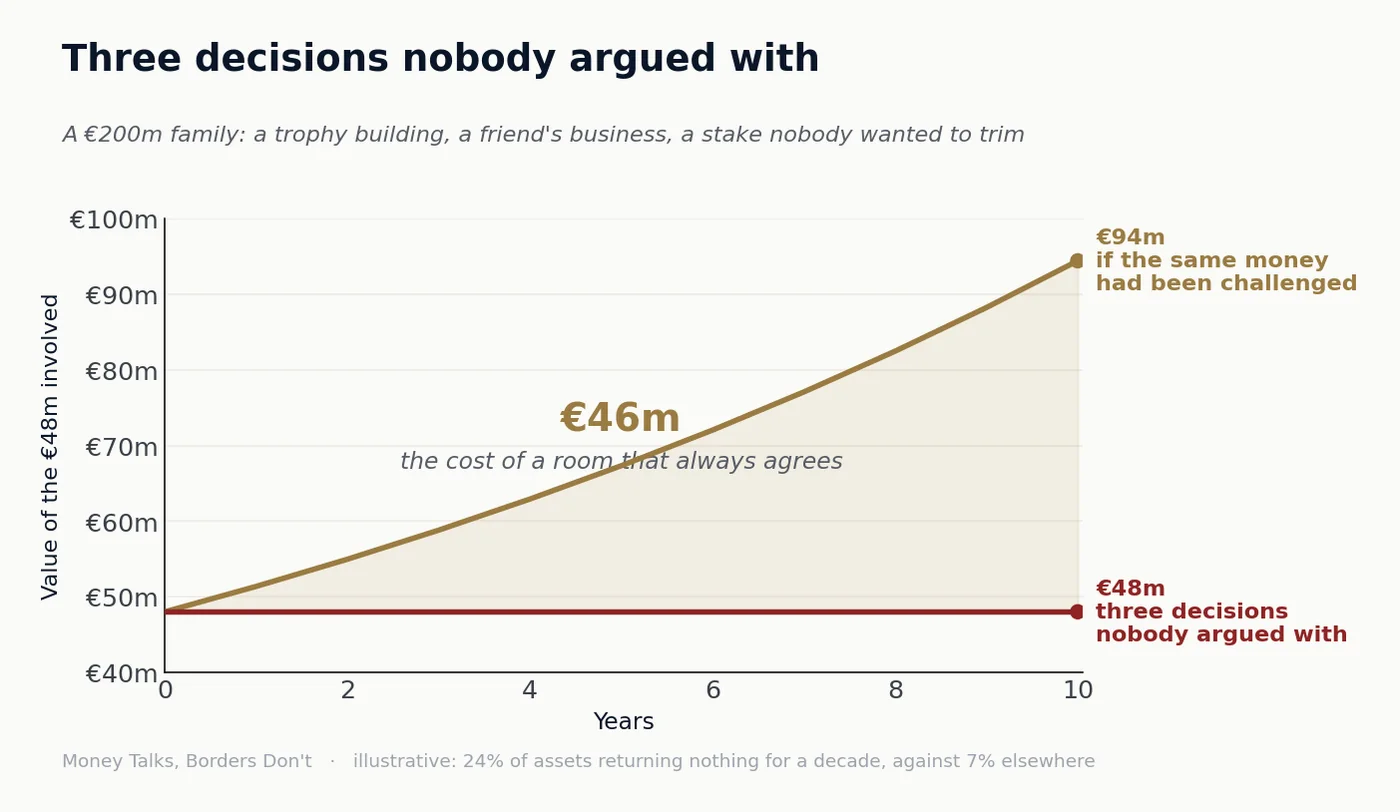
Take a family with two hundred million. Over a decade, three decisions get taken that nobody argues with. A trophy building bought at a yield that made no sense, because the principal had wanted it for years. A stake in a friend's business, where the real question was never asked. A concentrated holding that everyone agreed should be trimmed, in principle, later.
Call it 24% of assets, €48 million, producing nothing for ten years. Had the same money earned 7% elsewhere, it would be €94 million.
Forty-six million euros, which is 23% of the original fortune, lost to the fact that three conversations never happened properly. No fraud, no crisis, no bad actor. Just a room where the answer was always going to be yes.
And the worst part is that it's invisible. Nobody can point to the meeting where the mistake was made, because the mistake was the absence of a meeting.
How you engineer a no
The fix isn't moral, it's mechanical. Five things, and none of them are expensive.
Make dissent a role, not an act of bravery. Name someone for each significant decision whose job that day is to argue the other side, and rotate it. When objecting is an assignment, it costs nothing to do well.
Write before you talk. Before any large commitment, every participant writes down, privately, the two most likely reasons it fails, and those get read out before discussion. People say in writing what they won't say after the principal has spoken first.
Buy one voice you cannot easily remove. One external adviser, paid under a fixed arrangement, whose income doesn't depend on being liked next quarter. The point isn't that outsiders are wiser. The point is that their payoff matrix is different, and different payoffs produce different sentences.
Record the disagreement. If your minutes never contain a dissent, your minutes are a press release. Writing down who objected, and why, costs one line and changes the room permanently.
And agree the rules while nobody is excited. That's what an investment policy actually is: not a document, a decision taken in a calm month about what you'll do in a hot one. Only a third of offices have one, which tells you how most decisions get made.
The part for advisers, which is harder
I should be honest about the other side of this, since I sit on it.
Your job is not to be contrarian, and it isn't to be right. The principal's money is theirs, their goals are theirs, and plenty of decisions that look wrong on a spreadsheet are perfectly rational once you understand what a family actually wants. Disagreeing for sport is just a different way of being useless.
The job is narrower and harder: to make sure no was genuinely available. To say the uncomfortable thing once, clearly, early, and in a form that can be written down. After that the decision belongs to the principal, as it should.
Yes, that carries a risk. You can lose a mandate for it, and some people do. But consider what you're actually selling. An adviser's only real asset is the credibility of their no, because a yes from someone who never says no is worth nothing to anybody. Spend that credibility to keep a client comfortable and you've sold the one thing that made you worth paying.
The good news, in my experience, is that the principals worth working for know this perfectly well. They've usually been surrounded by applause for years and can tell the difference between an adviser and an audience within about ten minutes.
The rest will keep clapping. That's the arrangement, and everyone in the room understands it.
The last two metres
Which leads somewhere I want to spend next week on properly.
Notice what was never the problem in any of this. Nobody in those rooms lacked the technical answer. The valuation was right, the structure was sound, the risk was correctly measured. Competence wasn't scarce in a single one of those failures.
What was missing was the last two metres: the distance between a correct analysis and a decision the family actually takes. That stretch is made entirely of communication. How the thing is said, to whom, in what order, and at which moment. And it is the part almost nobody in our industry is trained for, because technical skill is what gets you hired and communication is what determines whether anything you know ever changes an outcome.
Analysis is becoming cheap and getting cheaper. The person who can take a difficult truth and land it in a room without the room closing is becoming the scarce one. More on that next week.
Applause you can predict isn't feedback. It's acoustics.
For analysis, not advice. The worked example is illustrative and describes no actual family. Every situation should be assessed with your own advisors.
---
Sources & notes
The opening refers to remarks made by the US president at a campaign rally in Clarksville, Tennessee, on Saturday 10 October 2026, widely reported the following day, in which he told supporters he could say the stupidest things and they would applaud. It is cited here solely as an illustration of a group dynamic and carries no political comment of any kind.
Governance data: the J.P. Morgan Private Bank 2026 Global Family Office Report, published 2 February 2026 and surveying 333 single family offices across 30 countries, found investment committees present in 64% of offices, formal investment policy statements in 35% and boards of directors in 32%, with 83% having some form of formal governance structure. Of offices with investment committees, 42% include both family and non-family members while 22% include only family members. The same study reported that 86% of family offices lack clear succession plans for their decision-makers. Separate benchmarking work by KPMG Private Enterprise and Agreus has found that 70% of family office professionals report to at least one family member, and 29% to more than one.
The payoff matrix is the author's own framing of a well-established problem in organisational economics, namely that the private cost of dissent to an individual is high while the benefit accrues mostly to the institution. The worked example is illustrative: €48 million, being 24% of a €200 million portfolio, producing no return over ten years against 7% compounding elsewhere. It describes no actual family.
References: J.P. Morgan Private Bank 2026 Global Family Office Report; Morgan Lewis analysis of family office governance, September 2026; KPMG Private Enterprise and Agreus benchmarking; contemporaneous news reporting of 11 October 2026.