September 29, 2026
Three funds, one bet
Last week both central banks raised rates. Frankfurt to 2.50%, Washington to 3.75%, its first increase since 2023.
Rate rises hit long-duration growth companies hardest, which in 2026 means the handful of names that have carried the whole market. And that raises a question most people have never actually checked, including plenty of professionals.
How much of your portfolio is those names?
Not your tech fund. Your whole portfolio, including the parts you bought precisely because they were supposed to be diversified.
The index changed shape and forgot to tell anyone
Start with the object almost everyone owns: the S&P 500.
The seven largest companies in it, the Magnificent Seven, were worth 12.3% of the index in 2015. In September 2026 they were 33.9%. The top ten hit a record 40.7% at the end of last year and have hovered near 38 to 40% since.
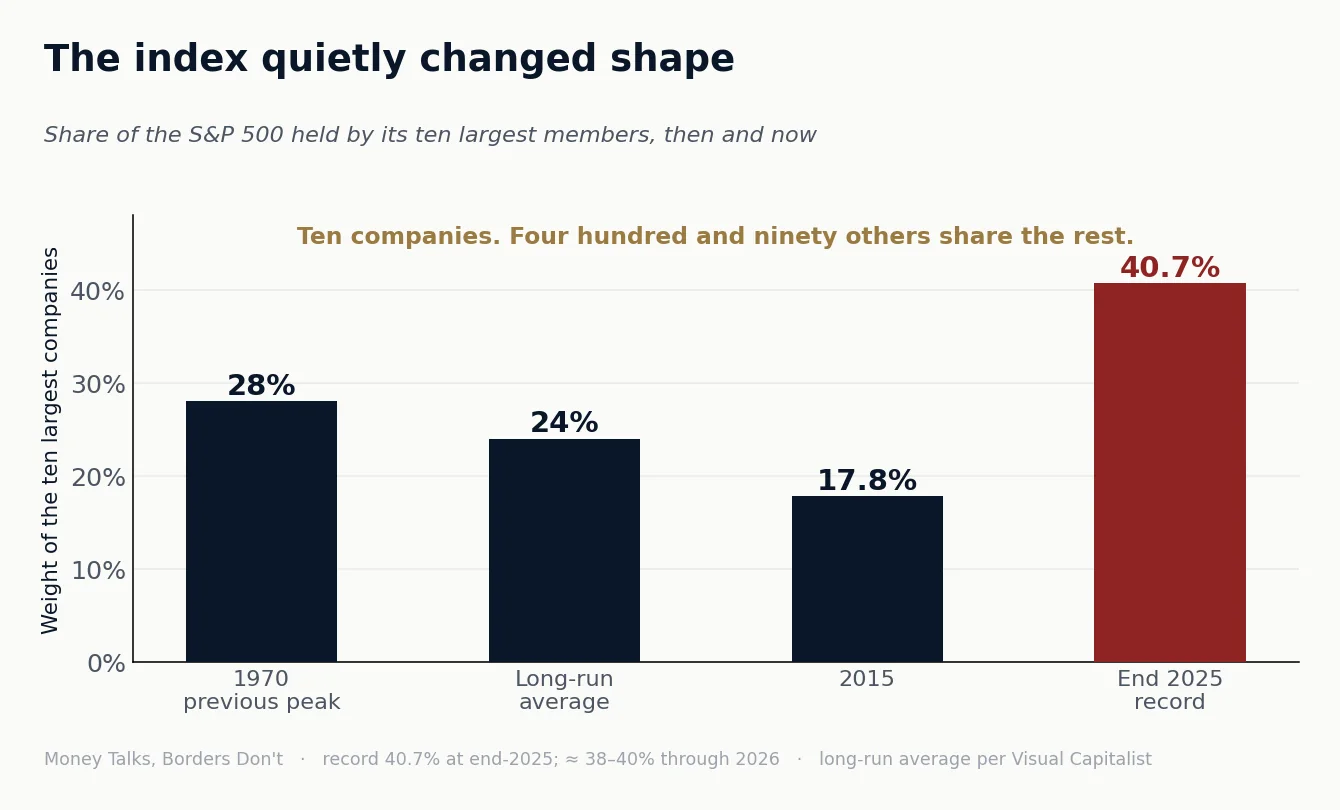
For context, the top ten have historically averaged around 24% of the index. Before this decade, the previous high point was 28%, back in 1970. We are roughly two thirds above the long-run norm, and well past a level that used to be considered extreme.
Nvidia alone is around 7.5% of the index. One company's guidance statement now moves the benchmark that half the planet uses to measure "the market".
None of this is a scandal, and it isn't an accident either. A market-cap weighted index is built to do exactly this. It holds more of what has gone up, automatically, by construction. That has been a wonderful feature: the seven drove most of the index's gains over the past three years, and anyone who owned the index got that ride without paying for it.
The point is narrower and more useful. The thing has become a different object from the one most people think they bought. It still says 500 on the label.
The look-through nobody does
Here's the part that makes it personal, and it's an exercise I'd genuinely recommend doing this week.
Take a family with three million euros in equities, arranged the way real portfolios actually get arranged, one decision at a time. One million in an S&P 500 tracker, bought because it's the core. One and a half million in a global equity fund, bought because it's broader and covers the whole world. Five hundred thousand in an AI or technology fund, bought because that's where the growth is.
Three products. Three separate decisions. It feels diversified.
Now look through to what's underneath.
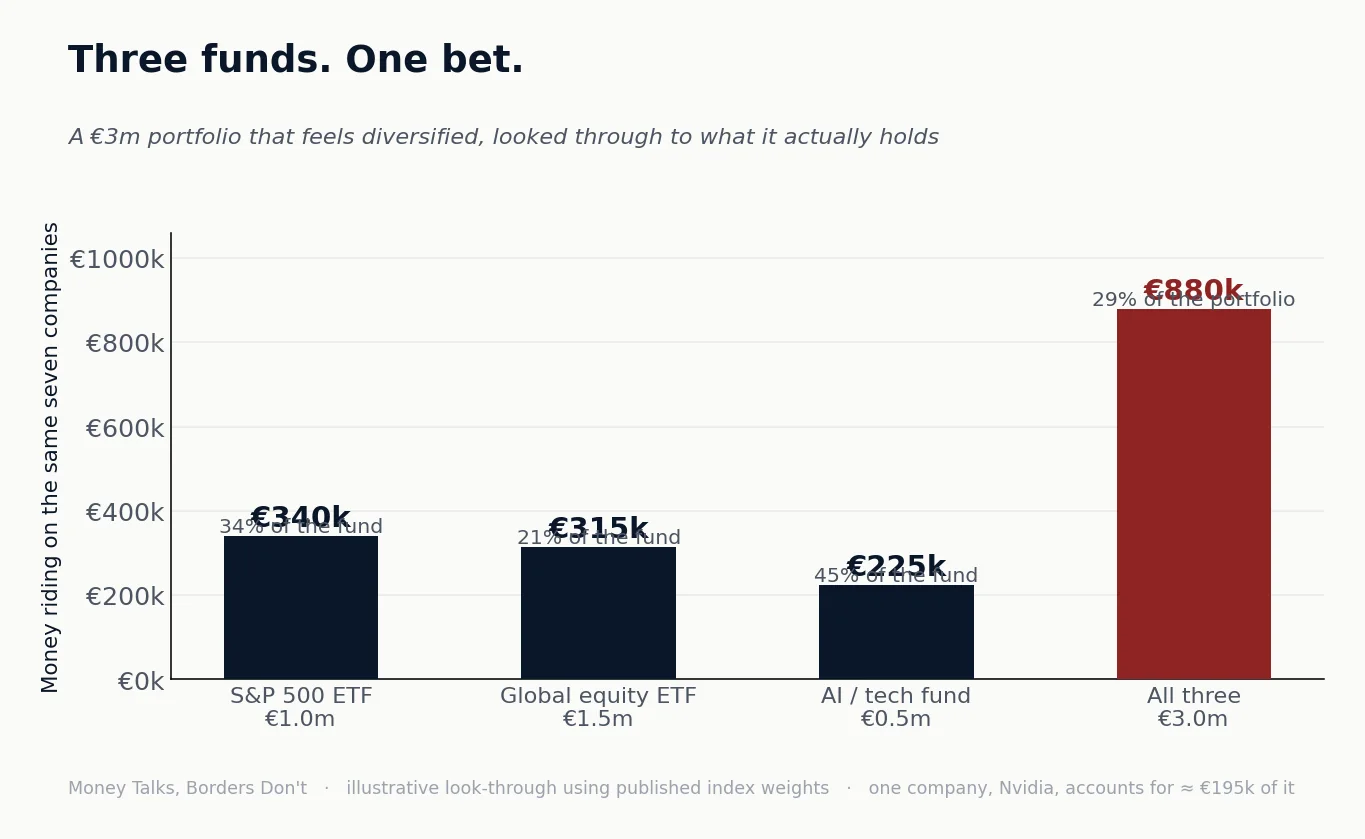
The S&P tracker puts about €340,000 into those seven companies. The global fund, which sounds like the opposite of a concentrated bet, holds over 60% of its money in the United States, which works out at roughly €315,000 in the same seven. The AI fund, unsurprisingly, is around €225,000.
Add them up and about €880,000 of a three million euro portfolio, near enough 30%, sits in seven companies. One of them, Nvidia, accounts for roughly €195,000 on its own, which is more than 6% of everything, from a family that never once decided to put 6% of its wealth into a single semiconductor business.
The diversification was real at the level of products. It disappeared at the level of risk.
The weighting rule is the decision
Here's the detail I find most elegant, and the one worth taking away even if you never touch your allocation.
Take the same 500 companies. Change one thing, the weighting rule, so that each holds an equal slice instead of a market-cap slice. The seven giants go from about 34% of the fund to about 1.4%.
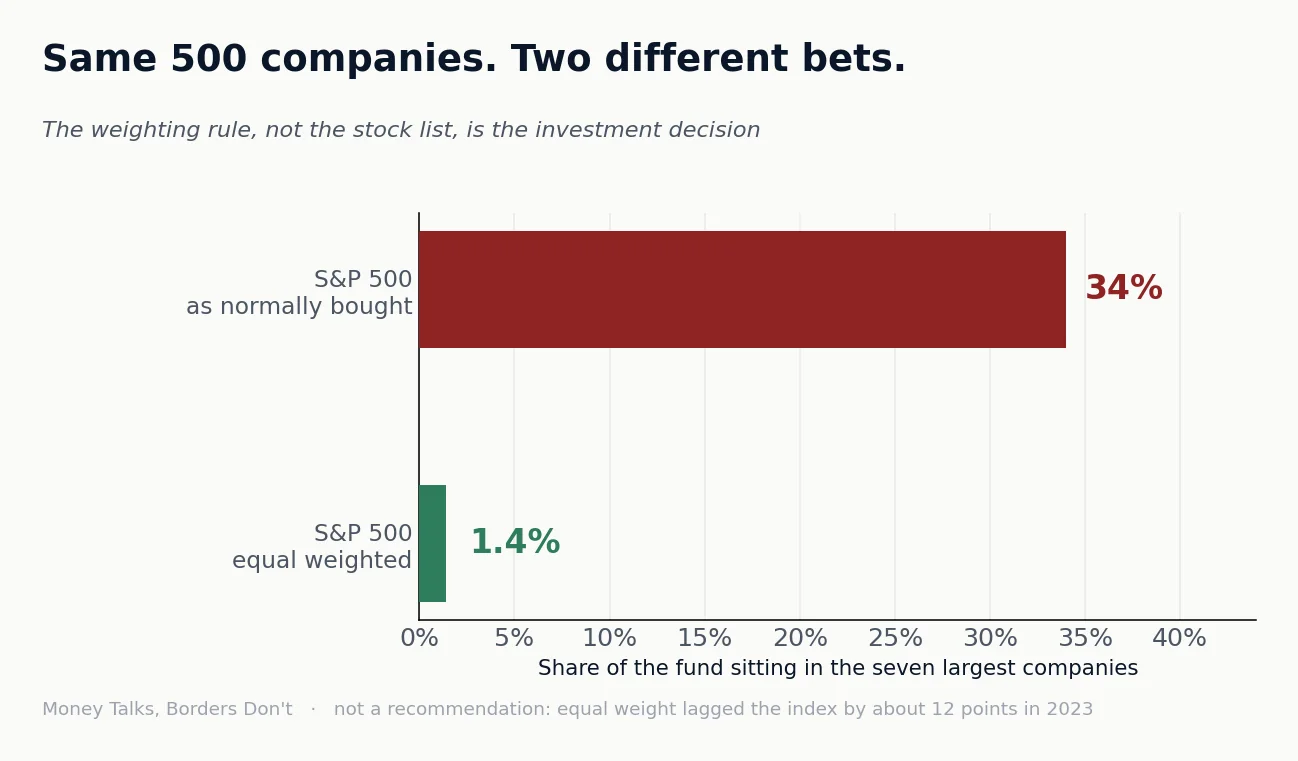
Same companies. Same country. Same index provider. A completely different investment.
Which tells you where the real decision lives. It isn't the stock list, and it isn't the fund manager, because there isn't one. It's the arithmetic rule sitting inside the product, and that rule is a choice somebody made, usually decades ago, that nobody in the chain ever re-examines.
And I want to be honest about the other side, because this is where a lot of commentary gets sloppy. Equal weighting is not the safe answer. It lagged the normal S&P by about 12 points in 2023 alone, and anyone who "de-risked" into it three years ago has spent the time since watching the concentration they avoided do all the work. Concentration has been the winning bet. It just isn't a neutral one.
The honest summary is this: passive investing is not the absence of a bet. It's a bet on continued concentration, made by default, by people who mostly believe they haven't made a bet at all.
Three things to do with this
Look through, once. Ask your bank or your platform for a look-through of your equity holdings by single name. Any decent private bank can produce it. Most families have never requested it, and the number that comes back is usually larger than the one they expected.
Decide the number rather than inherit it. There is no correct exposure to seven American technology companies. Thirty percent might be exactly right for a family with a long horizon and no need for the money. It's probably wrong for one funding a purchase in three years, or borrowing against the same portfolio, because that's the book where a concentrated drawdown turns into a margin call. When the index fell 20.4% in 2022, those seven names fell 41.3%.
And know which bet you're in. If you like the concentration, keep it, deliberately, and say so out loud. If you don't, the fix isn't dramatic: a slice in equal weight, a genuine allocation outside the United States, and the habit of measuring exposure by company rather than by product.
The index does one job very well. It tells you what the largest companies did. Somewhere along the way we started using it to answer a different question, which is what a diversified portfolio should look like, and those two answers have been drifting apart for a decade.
Five hundred names on the label. Seven of them driving the outcome.
For analysis, not advice. Index weights move daily and the look-through figures here are illustrative, built from published weights. Nothing here is a recommendation to buy or sell any fund. Every situation should be assessed with your own advisors.
Sources & notes
Concentration: the Magnificent Seven (Alphabet, Amazon, Apple, Meta, Microsoft, Nvidia, Tesla) represented 33.9% of the S&P 500 as of 16 September 2026, with a combined market capitalisation around $23.8 trillion, having ranged between roughly 32% and 35% over the past year; they were 12.3% of the index in 2015 and 34.3% in December 2025. The top ten holdings reached a record 40.7% at the end of 2025, per data compiled by Pensions & Investments, and have run at roughly 38 to 40% through 2026. Historically the top ten have averaged about 24% of the index, with a previous high of 28% in 1970. Nvidia's weight is around 7.5%. The top ten account for roughly 41% of index weight against about 32% of index earnings (Motley Fool; Walnut Invest compilation; Forbes; ClaritX; Armstrong Fleming & Moore; Lord Abbett).
Global funds: the MSCI ACWI, which spans nearly fifty countries, holds over 60% of its weight in US equities, a consequence of market-capitalisation weighting; the developed-markets-only MSCI World version is higher still (MSCI; Stockember). The look-through example applies published index weights to a stylised €3m allocation: 34% Magnificent Seven weight for the S&P 500 tracker, approximately 21% for a global fund (34% applied to a US weight above 60%), and 45% for a thematic technology fund, which varies widely by product. Figures are rounded and illustrative rather than precise.
Equal weighting: in the S&P 500 Equal Weight Index the seven largest names account for roughly 1.4% combined; the equal-weight index underperformed the standard S&P 500 by about 12 percentage points in 2023 (ATB Financial; CME Group commentary via Seeking Alpha). Drawdown comparison: in 2022 the S&P 500 fell 20.4% while the Magnificent Seven fell about 41.3% (Motley Fool research).
Central banks, for context: the ECB deposit rate rose to 2.50% effective 16 September 2026 and the Federal Reserve raised its target range to 3.75% to 4.00% on 16 September 2026, its first increase since July 2023.
References: The Motley Fool, Forbes, Lord Abbett, ATB Financial, ClaritX, Armstrong Fleming & Moore, Walnut Invest, MSCI, Stockember, Federal Reserve, European Central Bank.