November 5, 2026
The other list
Some days ago, in Paris, the Financial Action Task Force ended something that had been running for twenty-eight months. On 30 October, at the close of its plenary, it removed Monaco from the list of jurisdictions under increased monitoring. Bulgaria, Côte d'Ivoire and the Democratic Republic of the Congo came off the same day. Nobody was added, and the grey list fell from twenty-two jurisdictions to eighteen.
Here, the reaction was warm and measured. The Minister of State called compliance a matter of credibility and stability for the financial centre, said the government does not see this as a finish line, and confirmed that the bodies coordinating the national strategy stay in place. A good answer, and more honest than most.
I wrote about Monaco scoring thirty-nine out of forty on the technical rulebook while staying grey-listed, and about why the examiners had stopped grading the rules and started grading the results. That process has now finished. Assessors came in September, found that the machine runs rather than merely exists, and the file closed.
So what actually changes for a family that banks here?
Less than the headlines suggest, and the reason is a second list that almost nobody has mentioned this week.
Three lists, one country
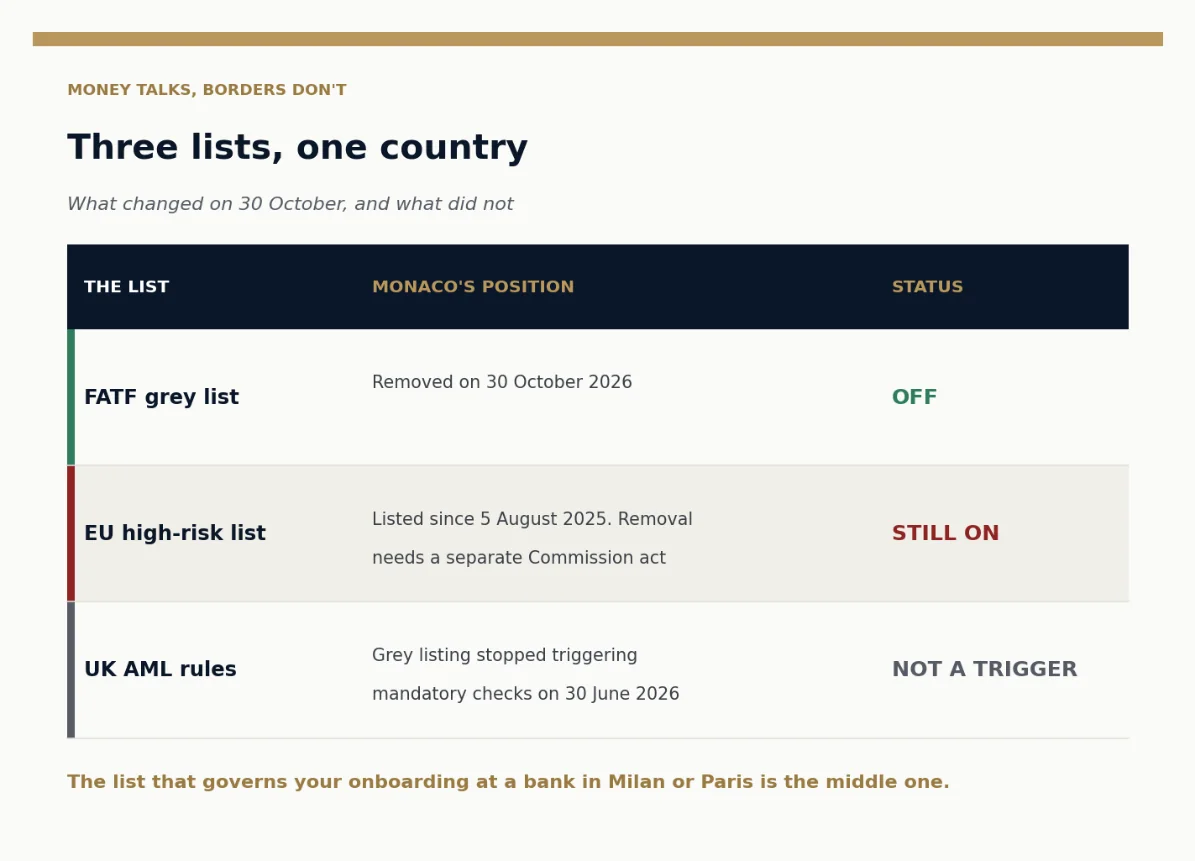
Monaco is off the FATF grey list. Monaco remains on the European Union's list of high-risk third countries, where it has sat since 5 August 2025.
These are different instruments with different consequences, and the difference is the whole practical story. The FATF list is an assessment and a signal. The EU list has teeth: a bank in an EU member state must apply enhanced due diligence to a business relationship involving a listed third country. Not may. Must.
And coming off the EU list is a separate act. The Commission has to adopt a delegated regulation, which then runs through its own scrutiny period before it takes effect. The Commission's table was last updated in January 2026, and it still shows two countries that left the FATF grey list back in June.
Which produces the sentence worth carrying out of this piece: the list that governs your onboarding at a bank in Milan or Paris is not the list that changed on 30 October.
The United Kingdom, for what it's worth, went the other way. Since 30 June 2026, grey-listing no longer automatically triggers mandatory enhanced checks under the British money laundering rules, so for a UK counterparty the delisting changes a country risk assessment rather than a legal obligation.
Twenty-eight months, and what is still in front
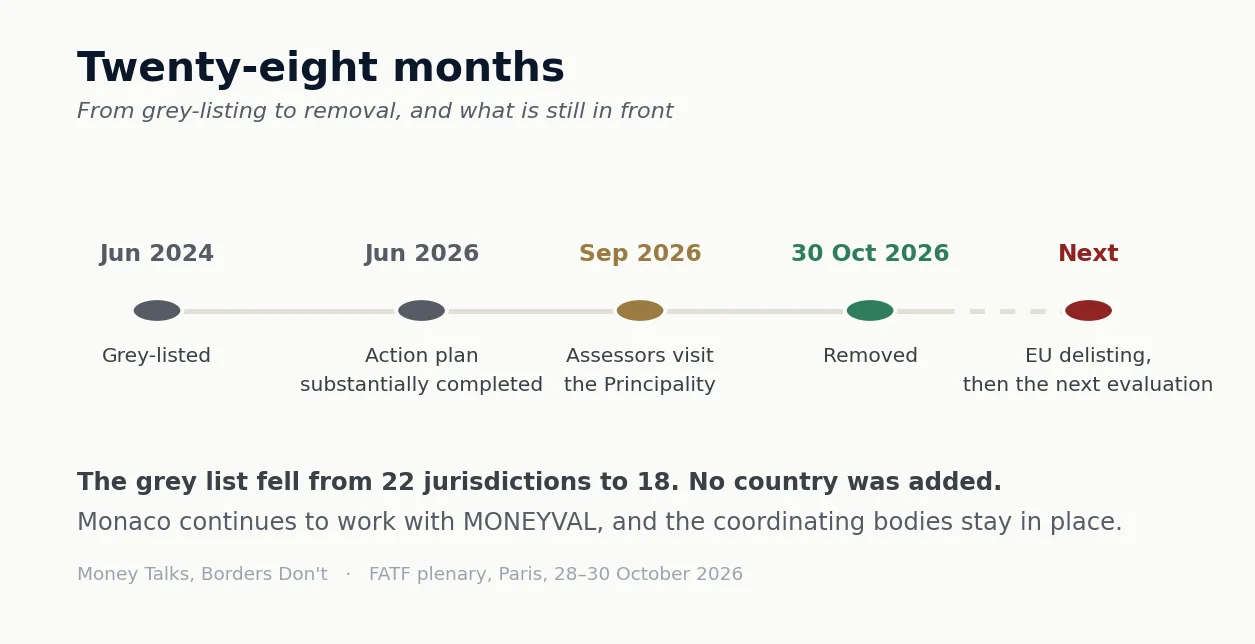
Worth keeping the sequence in view, because it tells you how these processes actually move. Grey-listed in June 2024. Preliminary determination in June 2026 that the action plan was substantially completed. Assessors on the ground in September. Removal on 30 October.
Twenty-eight months, with the last five of them spent waiting for a visit that confirmed what the June statement had already said.
What is still in front: the European delisting, on a timetable nobody controls from here, and then the next full evaluation under MONEYVAL, which will go back to grading effectiveness rather than statutes. The government has kept the coordinating structures alive precisely because that evaluation is coming, which is the right call and a slightly unusual one. The normal institutional reflex after clearing an exam is to dismantle the study group.
What a family actually notices
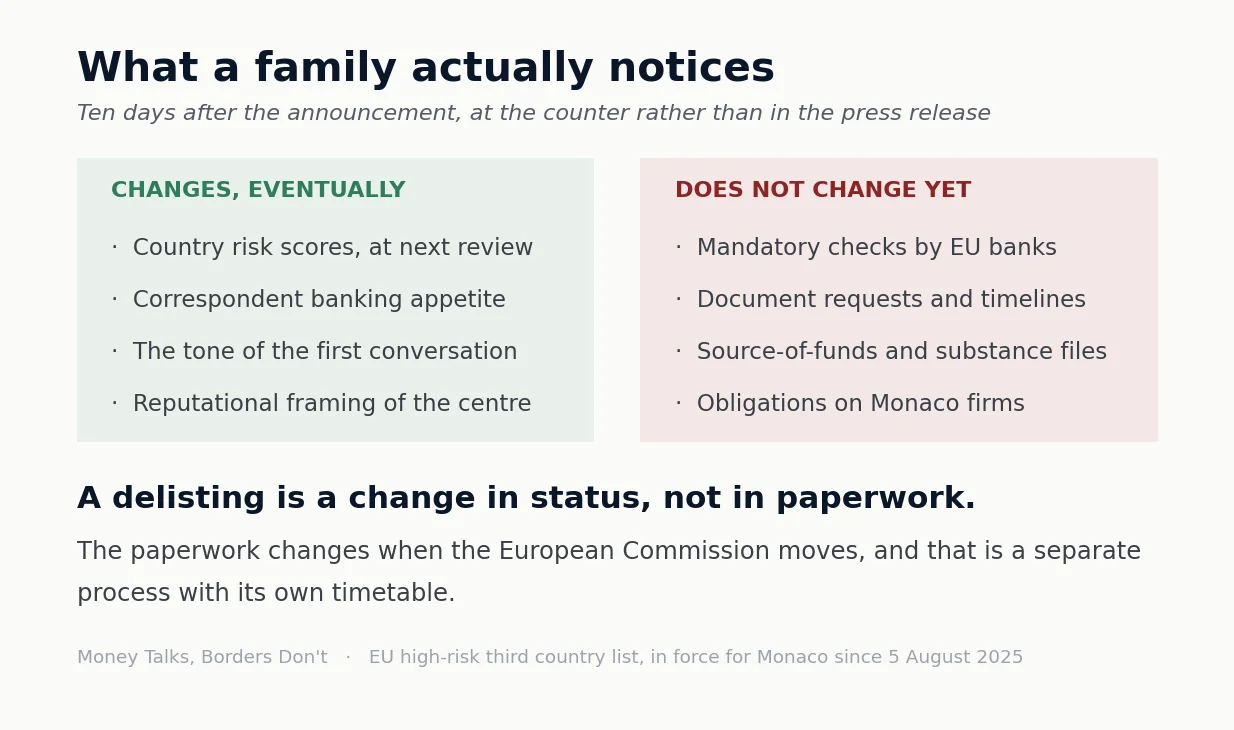
Let me separate the two columns honestly, because advisers here will be tempted to oversell this week.
On the left, what changes, and mostly not immediately. Country risk scores inside banks' internal models will be revised, but those models are updated on review cycles, not on press releases, so the effect arrives in months rather than days. Correspondent banking appetite improves, which matters more than most families realise, because it operates upstream and invisibly. The tone of the first conversation with a new counterparty changes. And the reputational framing of the centre improves, which is real even where it is unmeasurable.
On the right, what does not change yet. The mandatory enhanced checks applied by EU banks, because those follow the EU list. The document requests and the timelines. The source-of-funds files and the substance questions. And, most importantly, the obligations on Monegasque firms themselves, which come from Monaco's own law and from the AMSF, not from the FATF.
A delisting is a change in status, not a change in paperwork. The paperwork changes when the Commission moves.
The governance half, which is where the risk now sits
Now the part I find most interesting, and it is a question about institutions rather than about forms.
Twenty-eight months of reform produced a very specific thing: a supervisory apparatus that started doing what it was designed to do. Investigations opened. Sanctions decisions published, which I wrote about in June, and which matter precisely because an enforcement power nobody has ever seen used is indistinguishable from one that does not exist.
The risk now is the oldest one in institutional life. Pressure built the machine, the pressure has just been removed, and the thing being measured at the next evaluation is whether the machine keeps running without it. Effectiveness ratings are not awarded for having passed once. They are re-tested, from scratch, on what happened in the intervening years.
For firms here, that has a practical translation. The standard did not fall on 30 October. If anything the implicit standard rose, because a jurisdiction that has just been delisted is one whose next file will be read with the question "did it hold?" in mind. The families and the firms that treat this as permission to relax are the ones who will create the case studies for the next round.
And for families specifically, I would resist one particular temptation this month: the idea that a structure which was marginal on substance in October has become acceptable in November because a list changed. Nothing about beneficial ownership, record-keeping, or the question of where decisions are genuinely taken has moved an inch. Those obligations never came from the grey list in the first place.
What to do with the week
Three things, and the first is the one nobody does.
Check whether your banking counterparties have actually updated anything. Ask, directly, whether their treatment of Monaco-connected relationships has changed and what they are waiting for. The answer tells you which list they run on, and some of them will not know.
Do not re-file anything on the strength of the news. If a structure or a relationship needed work in October, it needs the same work now, and a delisting is not an argument you can make to an inspector.
And note the second date in your diary. The European delisting, when it comes, is the one that will actually change the friction in your cross-border life, and it will arrive with far less fanfare than this one did.
Monaco spent twenty-eight months proving that a machine runs. The reward is a narrower kind of scrutiny, not the end of it. That is a good outcome, honestly described, which is more than most financial centres manage.
For analysis, not advice. List status and its consequences differ by jurisdiction and by institution, and the EU position is subject to a separate legal process. Take advice on your own arrangements.
---
Sources & notes
The FATF removed Monaco, Bulgaria, Côte d'Ivoire and the Democratic Republic of the Congo from its list of jurisdictions under increased monitoring on 30 October 2026, at the close of a plenary held in Paris from 28 to 30 October, the first under the presidency of Giles Thomson. No jurisdiction was added, and the list fell from 22 to 18. Monaco had been listed in June 2024; the FATF made a preliminary determination in June 2026 that the action plan had been substantially completed, and assessors visited the Principality in September 2026 before the removal was confirmed. Monaco continues to work with MONEYVAL (FATF plenary outcomes, 28 to 30 October 2026; FATF, Jurisdictions under Increased Monitoring, 30 October 2026).
Monaco's government response, reported on 30 October, confirmed that the bodies coordinating the national strategy remain in place, with the Minister of State, Christophe Mirmand, describing the outcome as recognition of reform rather than a finish line and linking compliance to the credibility and stability of the financial centre (Monaco Life; Hello Monaco).
On the European Union list: Monaco remains on the EU list of high-risk third countries, in force since 5 August 2025. The Commission's table was last updated on 9 January 2026 and still showed jurisdictions that had already left the FATF grey list. Removal from the EU list requires a separate Commission delegated regulation with its own procedure (European Commission table, 9 January 2026, as reported; RegReportingDesk; AboutAML).
On the United Kingdom: since 30 June 2026, FATF grey-listing no longer triggers mandatory enhanced due diligence under the Money Laundering Regulations, so the removals affect country risk assessment rather than the mandatory population (AML Consultants; RegReportingDesk).
The FATF has stated that removal from the grey list does not automatically mean low risk, and that its listings do not of themselves require enhanced due diligence.
References: FATF (plenary outcomes and list statements, 30 October 2026); Monaco Life; Hello Monaco; ComplyAdvantage; RegReportingDesk; AboutAML; AML Consultants; Zyphe.