October 6, 2026
Not patient. Present.
Last Tuesday, RBC and Campden Wealth published their 2026 study of North American family offices. Buried in the commentary is the most honest sentence written about our industry this year, from the firm's research director: even patient capital can be caught up in the fear of missing out.
He's right, and the numbers around that line prove it. Artificial intelligence is the top investment pick for the next twelve months, chosen by 85% of offices. UBS found 65% of families already invested somewhere along the AI value chain, and 60% planning to change their strategic allocation within a year, the highest reading in the history of that survey. Reporting from September described family offices paying primary-style prices for secondary-stage risk, which is a polite way of saying they are bidding fast in a crowded room.
None of which sounds very patient.
So it's worth asking what the phrase actually means, because "patient capital" has become the thing every family office says about itself, usually in the first paragraph of the website, and almost nobody examines it.
Patience is two different things wearing one name
Here's the confusion at the centre of it.
The first thing is duration: the ability to hold for ten or twenty years because nobody can force you to sell. No fund life, no redemption calendar, no quarterly investor letter.
The second thing is attention: how much you actually shape what you own while you hold it.
These are completely independent, and the industry has quietly merged them. Duration gets sold as an edge. It isn't an edge. It's the absence of a constraint that other investors carry. Useful, certainly, but on its own it buys you nothing except a longer exposure to whatever happens to the asset.
Patience without attention isn't patience. It's drift with a good story attached.
The premium nobody invoices
And drift has a price, which is the part that rarely gets written down.
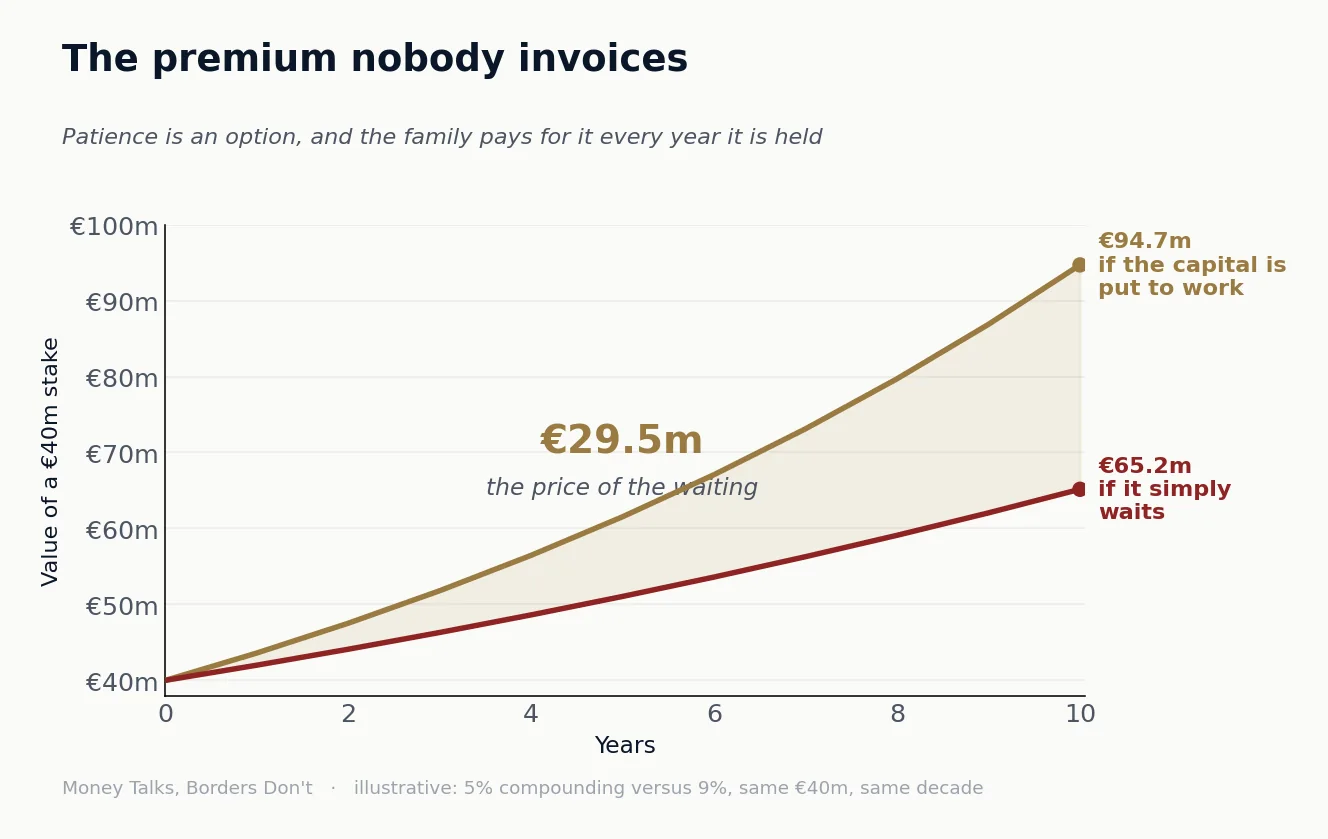
Take a family holding a €40 million stake in a decent business that compounds quietly at 5% a year. Nothing wrong with it. It pays, it employs people, grandfather built it.
Hold it for a decade and it's worth about €65 million. Had the same capital been put to work at 9%, whether through a repositioned version of the same company or somewhere else entirely, it would be €95 million.
That €29.5 million gap is the price of the waiting. It's real, it's paid annually, and no invoice ever arrives, which is exactly why nobody budgets for it.
So patience is an option, and the family pays the premium every year it holds. Which raises the only question that matters: what is the option supposed to buy?
What it's supposed to buy is influence
The answer, when the model works, is the ability to make decisions that no quarterly owner could make.
Rebuilding a business that will lose money for three years before it earns more. Firing a profitable product line because it has no future. Spending on systems with no visible payback until year four. Replacing a loyal manager who was right for the last decade and wrong for the next.
Those decisions destroy a public company's next four earnings reports. A family with duration can take them, and that is a genuine, structural advantage worth paying for.
But notice what the advantage requires. It requires somebody to be in the room, with a view, with the authority and the appetite to act on it. If the family's involvement is two board meetings a year and a set of accounts arriving in April, the option premium is being paid and nothing is being bought.
The clock got faster and the capital didn't
Here's why this matters more now than it did five years ago, and it's the point behind every AI line in those reports.
Patience used to be cheap. When industries changed slowly, waiting carried a small cost: a few points of compounding, as above, and not much else. Today the thing being repriced isn't the valuation multiple, it's the business model, and it reprices in quarters rather than decades.
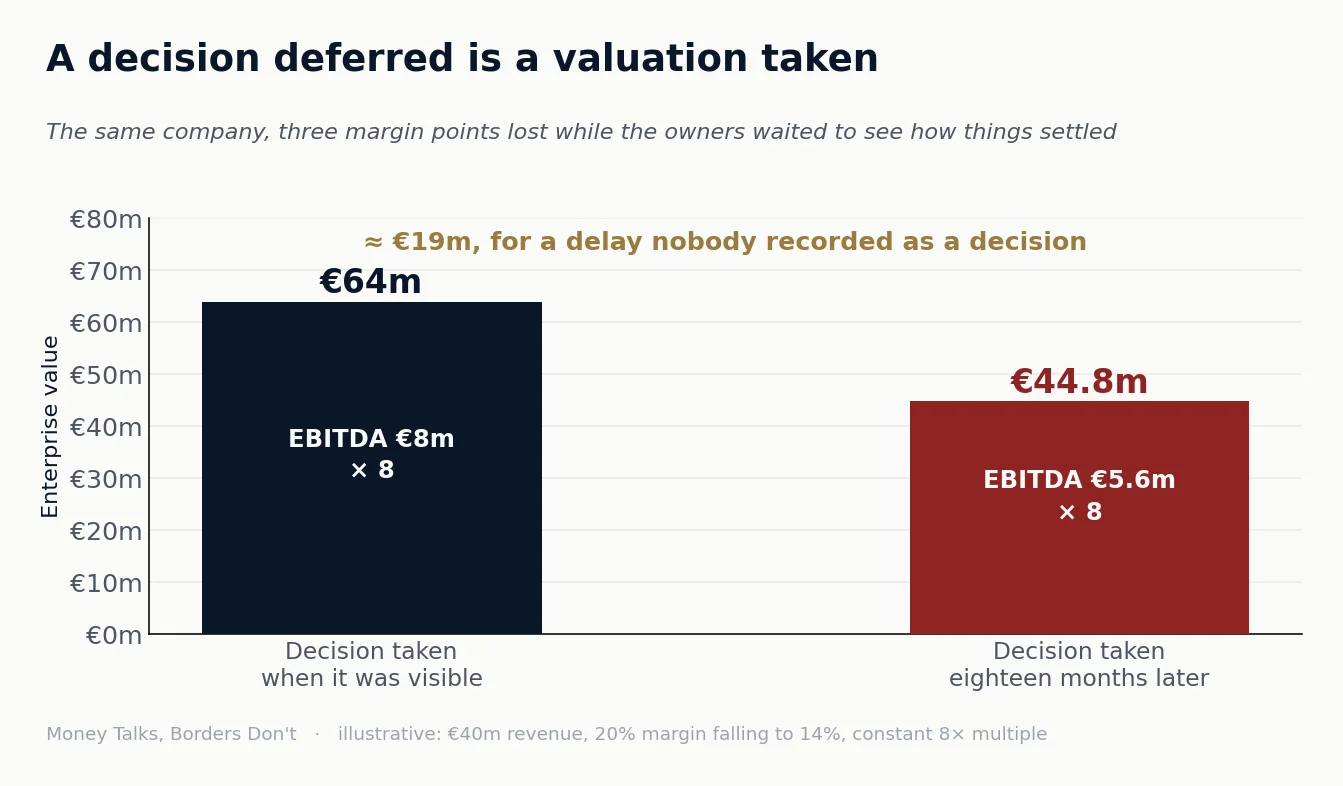
Take a services company doing €40 million of revenue at a 20% margin. Eight million of EBITDA, call it eight times, €64 million of value. A competitor rebuilds its delivery model, prices come down across the market, and the margin drifts to 14% over two years. Same company, same people, €5.6 million of EBITDA, €45 million of value.
Nineteen million euros, gone, from a decision nobody ever recorded as a decision. The minutes don't say "we chose to wait." They say nothing, because waiting doesn't require a resolution.
That's the asymmetry: acting is a decision, which gets debated, minuted and sometimes blamed. Not acting is a default, which gets neither. In a slow world the default was usually harmless. It isn't any more.
They bought the steering wheel
And here's the strange part, because families have actually moved in the right direction without quite finishing the job.
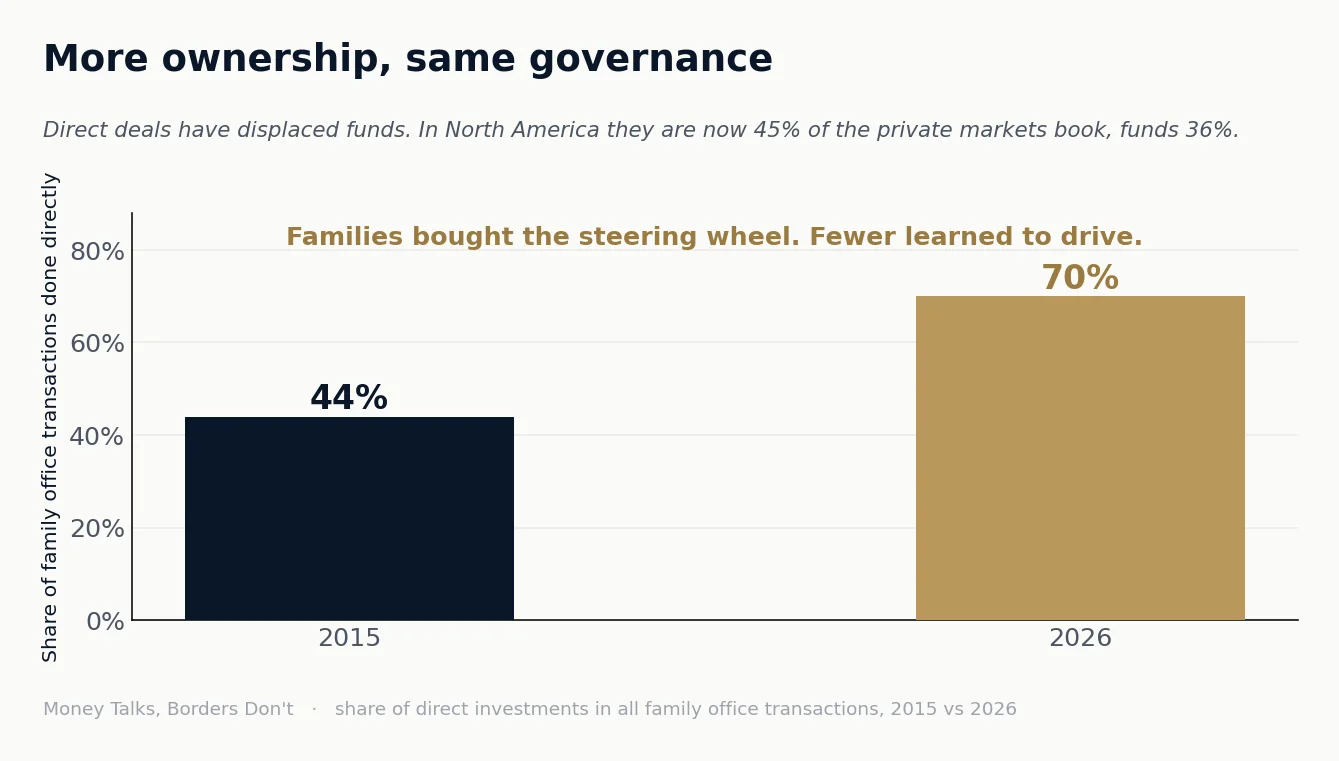
In 2015, direct deals were 44% of family office transactions. Today they're around 70%. In North America, direct investments now make up 45% of the private markets book, ahead of funds at 36%. Three quarters of the offices in Citi's 2026 survey invest directly, most writing tickets between one and twenty-five million.
Families have been buying control, deliberately, for a decade. They've bought the steering wheel.
What hasn't scaled at the same pace is the machinery to use it: the board seats with a real agenda, the operating people, the annual look at whether the business model still works, the willingness to be unpopular with a management team you've known for fifteen years.
So we end up with the inversion worth noticing. The money moves fast and pays full price on the new AI deal, where patience and price discipline would genuinely help. And it moves slowly, almost politely, inside the companies it already controls, where speed and presence are the only real advantages it has.
Three questions, not three slogans
For the families reading this, and for the offices that serve them, here's what I'd put on the agenda.
What is each holding actually for? Growth, income, employment, family identity, or sentiment? All five are legitimate. They are not the same, and a company held for sentiment should be labelled as such rather than quietly measured against assets held for return.
Where does the influence actually sit? If the answer is a board seat nobody prepares for, the duration is being paid for and not used. Pick the two or three positions where presence would change the outcome, and put real people and real time against them. For the rest, be honest that you are a financial investor and price the stake accordingly.
And what would have to be true for us to sell? Writing that down converts an open-ended hold into a decision with a test attached. Patience that can never be falsified isn't patience, it's an attachment.
The phrase we've all been using is wrong, or at least incomplete. The advantage was never the waiting. It was the ability to choose, and to be there while the choice plays out.
Not patient. Present.
For analysis, not advice. The worked examples are illustrative and describe no actual company. Every situation should be assessed with your own advisors.
Sources & notes
Current data: the 2026 RBC and Campden Wealth North America Family Office Report, published 29 September 2026, found artificial intelligence to be the top investment pick for the next twelve months among a combined 85% of offices, cybersecurity and data breaches the leading operational concern at 59% (up from 16% the previous year), 86% investing in private markets, and direct investments averaging 45% of the private markets book against 36% for funds; the quotation about patient capital and the fear of missing out is from Campden Wealth's director of research, Adam Ratner, in the accompanying release. The Citi Wealth 2026 Global Family Office Report, released 22 September 2026, surveyed 351 family offices from 41 countries in June and July 2026, finding 75% making direct investments, 73% writing tickets between $1 million and $25 million, AI the leading sector for direct investments over the next twelve months, and a reported allocation mix of 30% public equities, 16% fixed income, 12% cash, 10% direct real estate, 9% private equity funds and 9% direct private equity. The UBS Global Family Office Report 2026 surveyed 307 family offices across more than 30 markets with an average net worth of $2.7 billion, finding 65% invested across the AI value chain and 60% intending to adjust strategic asset allocation within twelve months, the highest level recorded in that study. The observation that family offices are paying primary-style prices for secondary-stage risk was reported by TechCrunch on 18 September 2026. The share of direct investments in all family office transactions is reported as having grown from 44% in 2015 to roughly 70% in 2025 to 2026 (Altss compilation); average direct deal counts fell from 18 in 2023 to 12 in 2025 while average ticket size rose from $8 million to $14 million.
Worked examples: both are illustrative and describe no actual company. The first compares €40 million compounding at 5% and at 9% over ten years. The second assumes €40 million of revenue, a margin falling from 20% to 14%, and a constant 8× EBITDA multiple, which deliberately isolates the operating effect from any change in valuation.
References: RBC and Campden Wealth (29 September 2026), Citi Wealth Global Family Office Report 2026, UBS Global Family Office Report 2026, J.P. Morgan Private Bank 2026 Global Family Office Report, TechCrunch, Altss, and contemporaneous coverage.