November 17, 2026
Interim
What a market priced in one week, and what a family never prices at all
On Thursday 12 November Nvidia announced that Jensen Huang had resigned as chief executive, president and board member, effective immediately, and that Colette Kress, the chief financial officer, would run the company on an interim basis while the board looked for a permanent successor.
Interim. That word is doing an enormous amount of work.
It means an answer exists, but only as a placeholder. Somebody is in the chair and nobody has yet decided whether they should be there. Kress is by every account formidable and has been at the company more than a decade; her competence was never the thing the market was worried about. What the market did with the word is the thing.
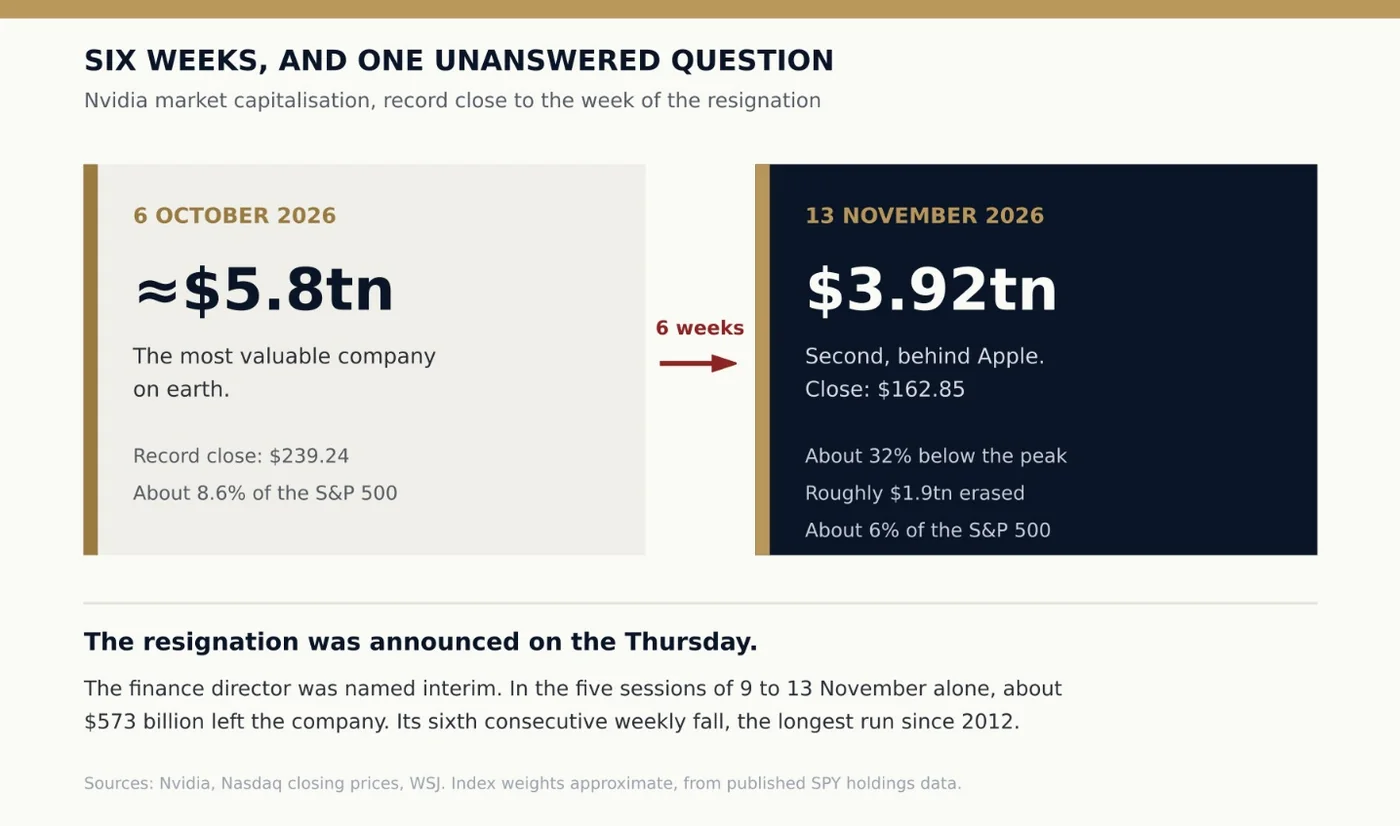
The stock fell as much as 14.4% during Thursday's session, touching $148.80, a fifty-two week low, before recovering to close at $166.19, down 4.3%. It lost another 2% on Friday and finished at $162.85. By the end of the week Nvidia was worth about $3.92 trillion, roughly 32% below the record close of $239.24 it had set on 6 October, which was enough to drop it to second place behind Apple after a stretch as the most valuable company in the world.
Across those five sessions the company shed around $573 billion. Its worst week since April 2025, the sixth consecutive weekly decline, and the longest losing run since 2012. Measured from the October peak, something close to $1.9 trillion of market value has gone.
None of that is only about one man leaving. The board had already opened an investigation, a proposed securities class action had been filed on 9 November over alleged ties between the chief executive and a suspected foreign agent, and the whole AI complex had been jumpy for weeks before any of this. But the acceleration came on the Thursday, and the reason is not complicated. A chief executive left, and the honest answer to who runs this now was that we will tell you in a few months.
An investor at Questar Capital Partners gave CNBC one word for it: uninvestable. He meant the succession plan, or the absence of one, rather than the scandal.
The discount nobody applies
Nvidia has thousands of people pricing key-person risk every day, as a matter of routine, and has had them for years. The price on the screen on 6 October, at the record, already contained somebody's estimate of what the company was worth without Huang inside it. When the question stopped being hypothetical, that estimate got tested in public and found wanting, which is why the move was so violent.
A family holding has nobody doing that arithmetic at all.
No analyst publishes a note on what the structure is worth if the founder has a stroke in March. Nobody convenes to ask whether the bank in Geneva will actually accept instructions from the daughter in Milan, or whether the Luxembourg company can sign anything at all with one of its two directors unreachable. There is no screen and there is no price, so the discount stays invisible, and invisible feels a great deal like not existing.
Then it arrives in full, on a day chosen by nobody, when the one person who could have negotiated it is the person who is gone.
Markets take their key-person losses in instalments and in daylight. Families take theirs in a single payment, backdated.
The plan is not the problem
Most families now have a succession plan, and I want to be fair about this, because twenty years ago that genuinely was the gap and today it mostly is not. The documents exist. A good lawyer drafted them. They sit in a folder with a decent cover and somebody paid properly for the work.
They were also drafted in 2017.
Since then two accounts were opened and one was closed. The Luxembourg company changed administrator. A named director retired and moved to Portugal. The son who was going to take over got divorced, and the shareholders' agreement contains a clause about precisely that which nobody has read since the day it was signed, because reading it would mean raising it. The private bank was bought by a larger one and the relationship manager who knew the family left during the integration. The power of attorney refers to an account number that stopped existing in 2021.
None of that felt like a succession event at the time, so nothing triggered a review. Together they mean the plan in the folder and the situation in the world have quietly stopped describing each other, and nobody in the family could tell you when that happened, because it did not happen on any particular day.
Which is the distinction almost nobody draws. A plan is a document and readiness is a state. The document sits where you left it. The state decays by itself, with nobody doing anything wrong, simply because everything underneath it keeps moving.
Nobody decides to let a succession plan rot. It expires the way a passport does, in a drawer, and you find out at the airport.
So test it
This is usually the point where writing on the subject softens into governance frameworks and family charters. Let's go the other way.
Once a year, in the same month every year, somebody sits down for an afternoon and tests seven things. A review means reading a document and agreeing with it. A test means picking up a telephone to find out whether what you believe is still true, and then living with whatever comes back.
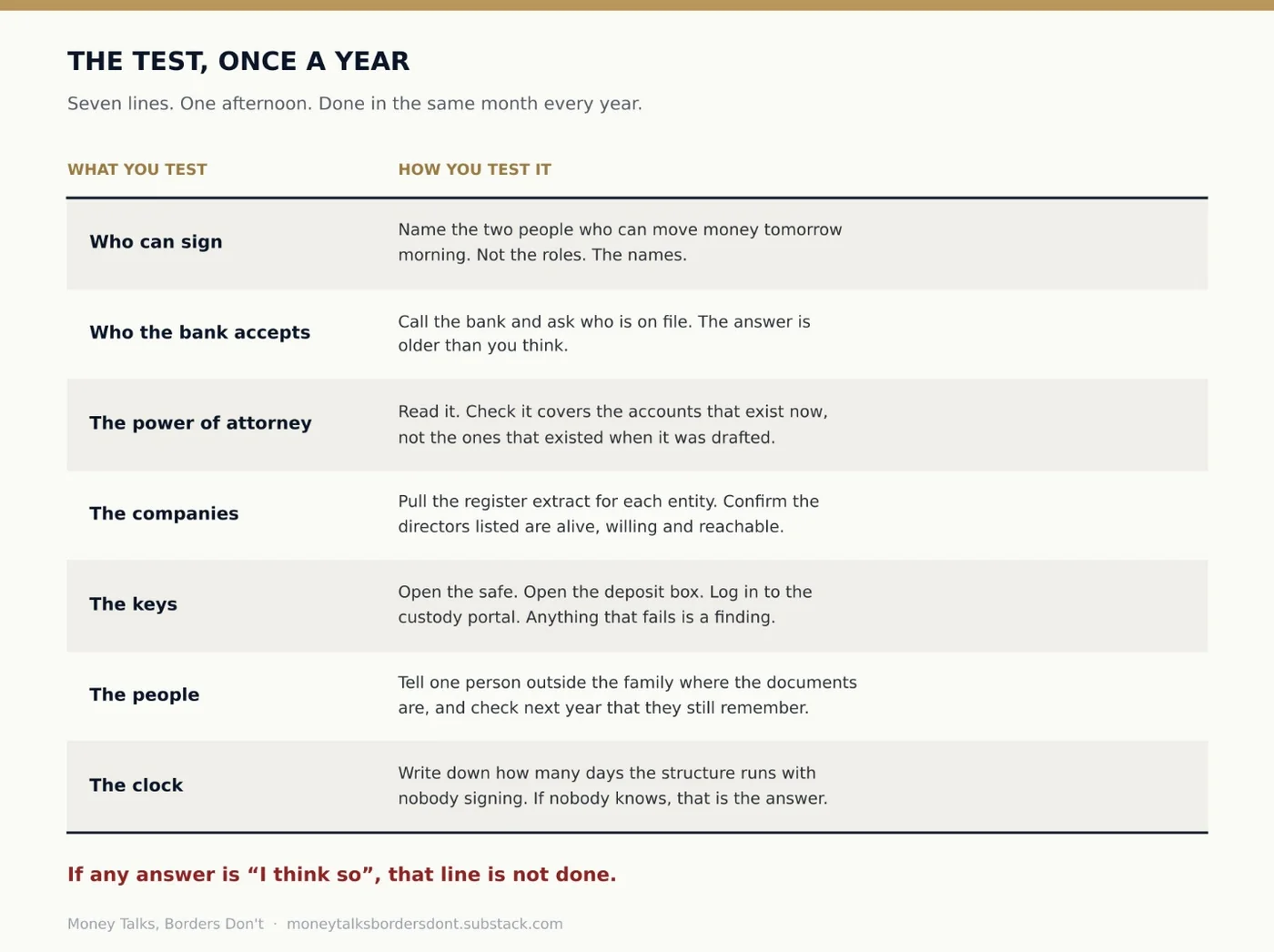
Seven lines, one afternoon. In most years nearly everything passes and the afternoon looks like a waste of a perfectly good Tuesday. It is not, because there are almost always two lines that fail, and the two that fail are never the two you had worried about on the way in.
The format is what makes it work. A review invites agreement, since everyone in the room has an interest in the document being fine and nobody enjoys being the person who questions something the family paid real money for. A test produces findings instead. You call the bank, you ask who is on file, and you either hear the names you were expecting or you do not. There is no comfortable middle where everybody nods and the meeting finishes early.
Which is why the rule underneath that table matters more than any individual line in it. If the answer is "I think so", the line is not done. I think so is the sound a structure makes shortly before it stops working. It means the last time anyone actually checked is far enough back that we have stopped counting, and we are filling the gap with the memory of having once been sure.
Picture a family that is certain two signatures are needed to move money out of a company. One of the two left the group a few years ago, on entirely good terms. Nobody told the bank, because telling the bank was nobody's job. So the structure runs on a single signature while everyone believes it runs on two, and one phone call would reveal it. Nobody has made a mistake here; the afternoon was simply never put in the diary.
The length of the word
Nvidia will have a permanent chief executive before long. The board is under severe pressure, the candidates are being discussed in public, results are due quickly with an interim chief executive presenting them, and on the day a name is announced the market will reprice again in whichever direction it decides. For a listed company, interim is a short word with a deadline attached to it.
A family gets no deadline and no announcement. Its interim runs from the moment somebody is gone until the moment the structure can act again without them, which on the optimistic estimate is eighteen months, and throughout it the assets stay exposed while the decisions that need taking do not get taken.
Nvidia's week cost about $573 billion, and every one of those dollars was visible to anyone who cared to look. The family version of that bill never gets printed. It gets paid anyway.
One afternoon a year. Same month. Seven lines.
---
Sources and notes
Nvidia announced the resignation of Jensen Huang and the appointment of chief financial officer Colette Kress as interim chief executive on 12 November 2026; the Form 8-K records the board accepting the resignation on 11 November. Harvey C. Jones was named the board's first chair, and third-quarter results remained scheduled for 17 November. The record close of $239.24 was set on 6 October 2026. On 12 November the stock reached an intraday low of $148.80, down 14.4%, before closing at $166.19, down 4.3%; it closed on 13 November at $162.85, down 2.01%, for a market capitalisation of about $3.92 trillion, second behind Apple at roughly $5.18 trillion and ahead of Microsoft at roughly $3.89 trillion. The week of 9 to 13 November cost about $573 billion of market value, a decline of 12.75%, the sixth consecutive weekly fall and the longest such run since 2012. Nvidia represented about 8.6% of the S&P 500 at the October peak and about 6% a month later; these index weights come from published SPY holdings data reported at second hand, not from the original State Street file, so they are approximate. The securities class action (Kistenmacher v. NVIDIA Corporation, Northern District of California, filed 9 November 2026) is a proposed class action and the allegations in it are untested. The "uninvestable" remark was made to CNBC by an investor at Questar Capital Partners, who attributed it to the absence of a succession plan.
The seven-line test is not a standard, a framework, or anybody's published methodology. It is a practitioner's working list, built from the things that turn out to be broken when somebody finally checks. The signature example is illustrative rather than a specific case.
For analysis, not advice. Nothing here is legal, tax or investment advice, and cross-border rules change frequently.
Money Talks, Borders Don't · moneytalksbordersdont.substack.com