November 10, 2026
Counting the wrong thing
It is the second week of November, which in my world means a particular kind of conversation.
Families who want their residence to change from January are deciding now. Some of them have been deciding since September. And almost every one of those conversations arrives at the same question, usually within the first ten minutes.
How many days can I spend there?
It is the wrong question. Not slightly wrong, not a simplification. It is an argument you reach third, if you reach it at all, and building a relocation around it is like preparing for an exam by memorising the final page.
Let me show you what actually decides these cases, and then one Swiss judgment from this year that should change how anybody thinks about a December move.
The day count is the third test, not the first
When two countries both claim you as resident, the treaty between them settles it. Almost every bilateral treaty reproduces the same tie-breaker, in the same order, from the OECD model.
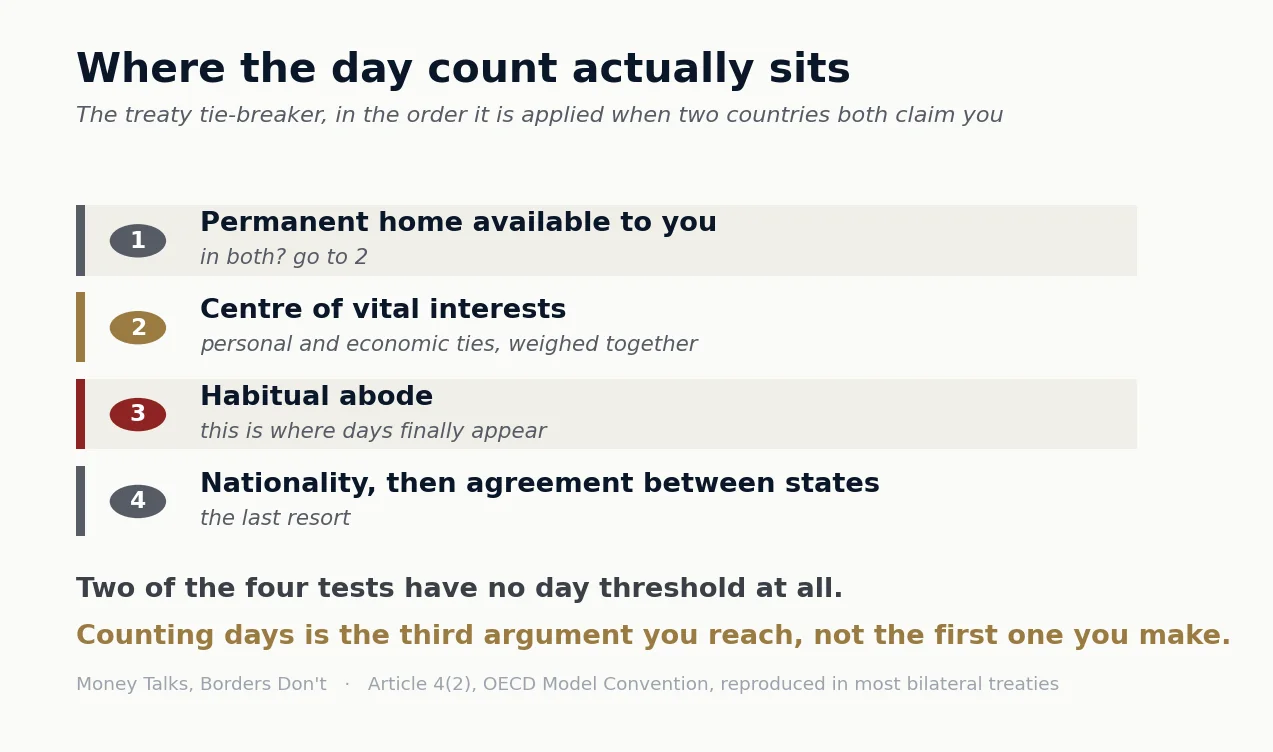
Start at the top. Do you have a permanent home available to you? Not owned, not occupied. Available. A flat kept furnished and ready in the country you left, even if you rarely sleep there, is a permanent home available to you, and plenty of people lose at this step without realising the step exists.
If there is a home in both places, the question becomes where your centre of vital interests sits: personal ties and economic ties, weighed together, as a single picture. Where the family lives. Where the children are at school. Where the business is run from. Where the doctor is.
Only if that cannot be determined do you reach habitual abode, and only there do days finally appear.
Two of the four tests have no day threshold at all. Which means the number everybody optimises for is the one that may never be consulted.
There is a well-known illustration of this, from a long Spanish case about a performer that was finally resolved earlier this year. She was acquitted for one of the years because the authorities could not show her centre of economic interests was in Spain, and the court noted she had spent 163 days there. Read that carefully. She was under 183 and the state still litigated her residence for roughly twelve years, and what decided it in the end was not the count.
The December move that moved nothing
Now the judgment I want you to carry into this month.
In February of this year, the Swiss Federal Supreme Court decided a case about a man who declared his departure from one canton to another on 16 December. The question was where he was tax resident for that whole year.
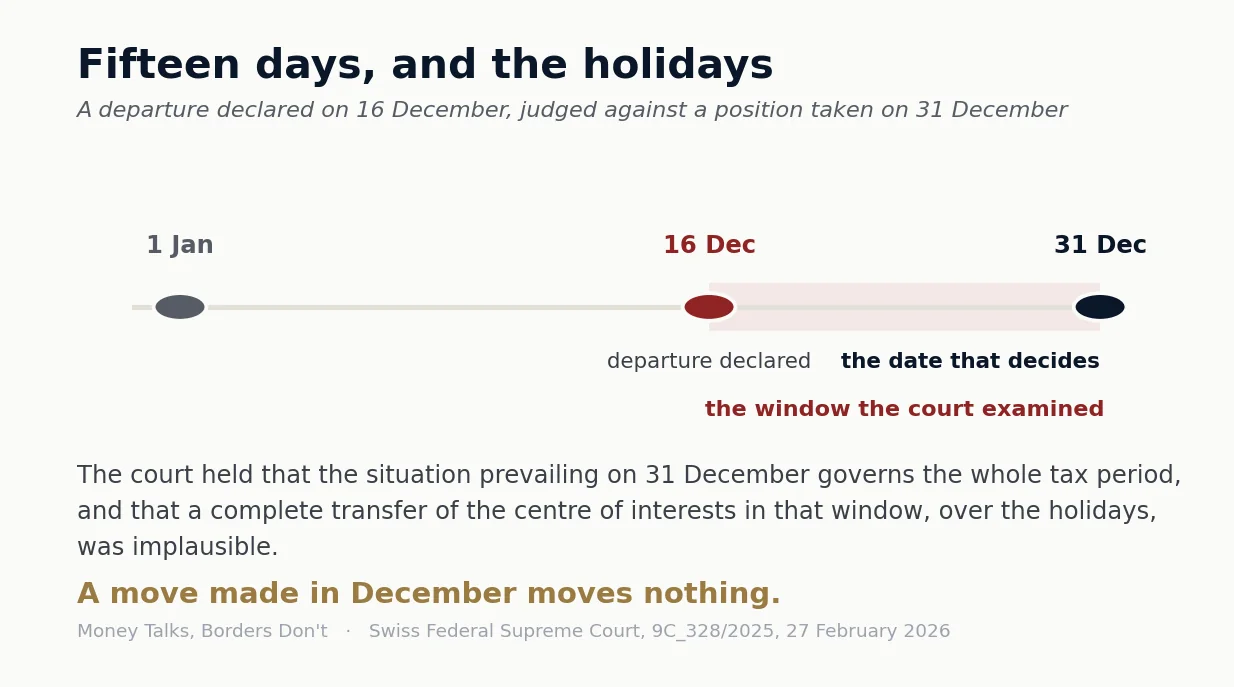
The court held two things. First, that the situation which governs the entire tax period is the one prevailing on 31 December. Second, and this is the part worth repeating at dinner, that the short period between a declared departure on 16 December and the end of the year, coinciding as it did with the holidays, made a complete transfer of the centre of interests implausible.
Fifteen days, most of them holidays, and the court simply did not believe it. Not because the man was dishonest. Because a centre of life is not a thing that relocates over Christmas.
That case was about two Swiss cantons, so the stakes were modest. Apply the same reasoning across a border and it is the difference between one tax system and another, for a full year, on everything.
I mention it in November for an obvious reason. If the plan is to be resident elsewhere from 2027, the work that makes that true does not start in late December. By late December the question has largely been answered by where your life visibly was for the preceding months.
What a file actually contains
So if not days, what?
This is the part I find families are never shown, and it is far more concrete than the law makes it sound. An administration challenging a residence does not argue about doctrine. It builds a picture out of ordinary traces, and it is remarkably good at it.
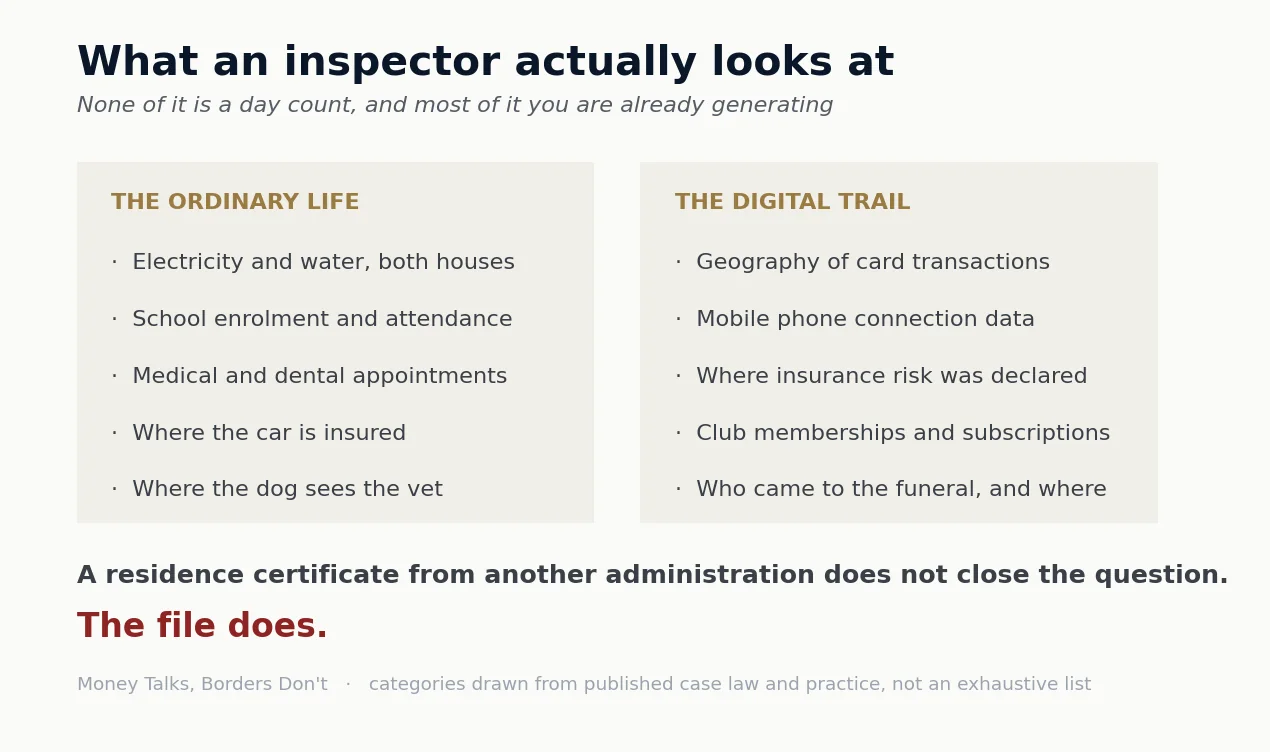
Electricity and water consumption in both houses, read month by month, which tells you which one was lived in and which one was heated for visits. School enrolment and attendance. Medical and dental appointments, which people book where they actually are. Where the car is insured and where it sits at night. The vet, which sounds comic until you realise the dog does not commute.
Then the digital half. The geography of card transactions, not the total but the pattern of small ordinary purchases. Mobile connection data. Where you declared the risk when you took out insurance, because people are honest with insurers in a way they are not with tax forms. Club memberships and subscriptions. And, in more than one reported case, who came to a family funeral and where it was held.
None of that is exotic, and none of it is about days. It is about where an ordinary life was visibly conducted, which is exactly what the treaty test asks.
One more thing, from a trio of Spanish decisions this year. In one of them the taxpayer held a residence certificate issued by the British tax authority, and the court decided the case on the evidence anyway, effectively setting the certificate to one side. In another, a residence declared in the Bahamas failed because no real link to that jurisdiction had been proved. In a third, concerning a footballer who played in Monaco and in Spain in the same year, the analysis was the same: not where the paperwork said, but where the life was.
A certificate from another administration is a document. The file is an argument. Documents lose to arguments.
Four things, if you are moving
Start before the year you want to be resident, not during it. The judgment above is the clearest statement I have seen of why a December transfer is a late transfer, and the same logic applies to a March one. Everything that makes a new centre of life real takes months to become visible.
Deal with the home you are leaving. A permanent home available to you is step one of the cascade, and a kept-ready flat is the single most common unforced error I see. Let it, properly, on a real lease, or stop keeping it ready.
Move the ordinary life, not just the address. The school, the doctor, the car, the insurance, the gym, the vet. These feel trivial, which is exactly why they are persuasive: nobody arranges them to win an argument, which is why an inspector trusts them.
And keep the file as you go, rather than reconstructing it later. Three years from now, nobody will remember which month you changed dentist. The documents will.
Everyone asks about days because days are a number, and a number feels like a rule you can satisfy. The actual test asks something much harder to fake and much easier to prove, which is where you genuinely live.
Fifteen days over Christmas was not enough. It was never going to be.
For analysis, not advice. Residence rules differ by country and by treaty, and every case turns on its own facts. Take advice on your own situation before acting.
---
Sources & notes
The tie-breaker sequence described here is that of Article 4(2) of the OECD Model Tax Convention, reproduced in most bilateral double taxation treaties: permanent home available to the individual, centre of vital interests, habitual abode, nationality, and finally mutual agreement between the competent authorities. Domestic law tests, which vary by country and may include day counts, centre of economic interests and family presumptions, apply before any treaty tie-breaker is reached.
The Swiss decision is Federal Supreme Court judgment 9C_328/2025 of 27 February 2026, concerning an intercantonal residence dispute. The court confirmed that the determining situation is that prevailing on the last day of the tax period, 31 December, and held that the short interval between a departure declared on 16 December and the end of the year, coinciding with the holiday period, made a complete transfer of the centre of interests implausible. Tax domicile, the court restated, rests on objective facts recognisable by third parties rather than on the taxpayer's stated intention. A companion decision, 9C_157/2025 of 19 March 2026, applied the same approach to a couple whose continuing social ties contradicted a claimed transfer.
On Spanish case law: commentary published in June 2026 reviews a series of 2026 Audiencia Nacional judgments on residence, including a decision of 10 February 2026 concerning a taxpayer holding a United Kingdom residence certificate, where the case was decided on the evidence; a decision of 15 April 2026 where a claimed Bahamas residence failed for want of any proven real link; and a decision of 5 March 2026 concerning a professional footballer who played in Monaco and in Spain within one year. A TEAC resolution of 19 February 2026 applied a case-by-case weighing of assets in a classic residence conflict.
The Spanish performer case referred to is a matter of public record; the acquittal for the 2011 tax year was announced on 18 May 2026, with the court noting 163 days spent in Spain and the failure to establish the centre of economic interests there.
The evidential categories listed are drawn from published case law and from professional practice. They are illustrative and not an exhaustive list.
References: OECD Model Tax Convention, Article 4; Swiss Federal Supreme Court 9C_328/2025 and 9C_157/2025 (via Silex Legal); Garrigues tax commentary, June 2026; contemporaneous reporting of the Spanish proceedings; practitioner commentary on Italian and Spanish residence tests.